


bgunderlay bgunderlay bgunderlay
123

Can an RPKI-Valid Route Still Be Hijacked? What IPv4 Owners Should Know

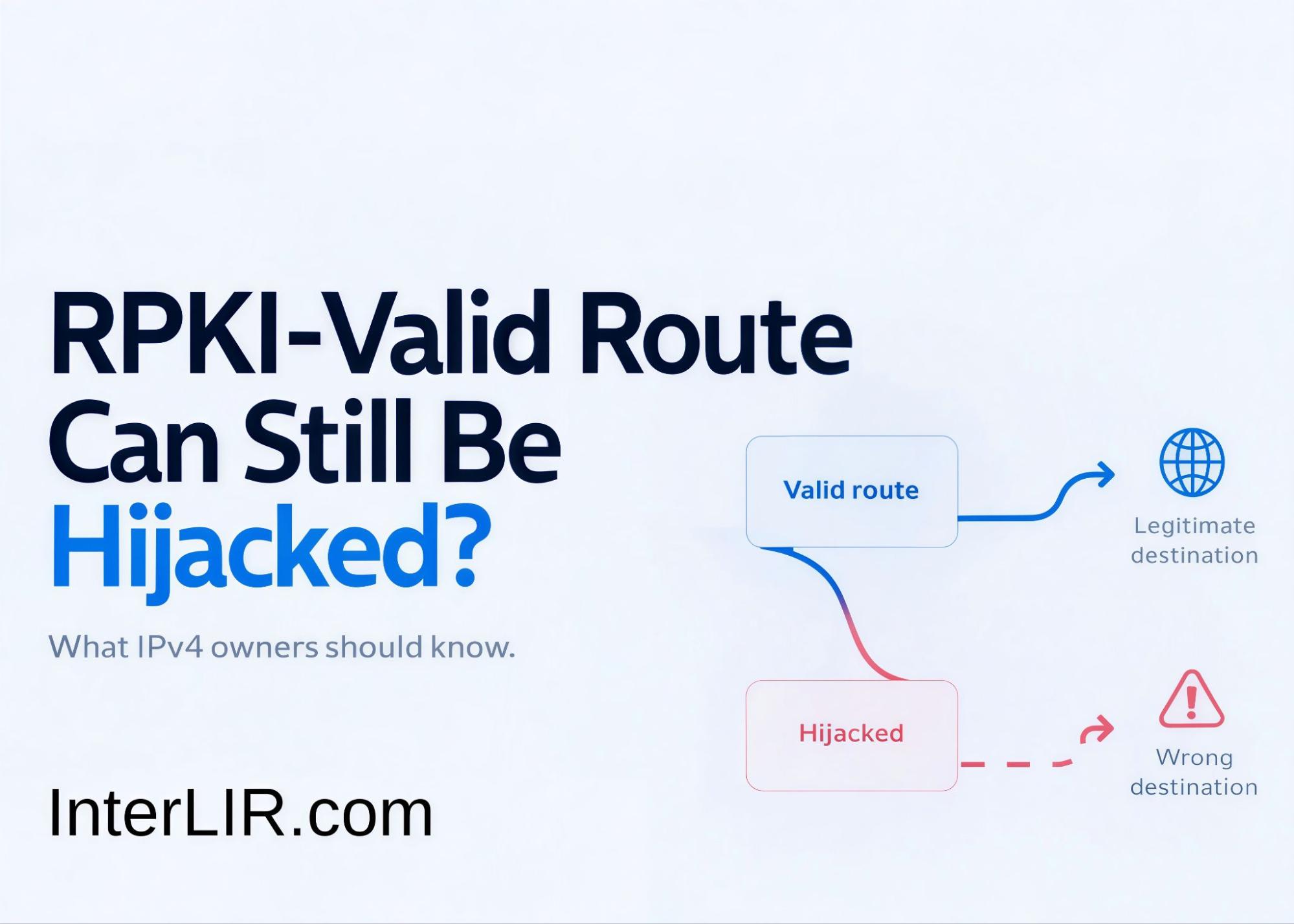
Your IPv4 prefix has a valid ROA. Your monitoring dashboard shows RPKI: Valid. Does that mean the route is safe? Not necessarily.

In August 2026, infrastructure used by Softaculous and Virtualizor was affected by a BGP hijack in which a more-specific /24 was announced inside a legitimate /16. Traffic was redirected to attacker-controlled infrastructure during two separate periods between August 28 and 30. The incident also enabled the attacker to obtain valid TLS certificates and contributed to a malicious Virtualizor update reaching a small number of installations. The unusual part was that the malicious route was still considered RPKI-valid.

Key takeaway: RPKI-valid does not automatically mean route-trusted.

For IPv4 owners, lessees and network operators, the incident shows why routing security needs to go beyond checking whether a route simply passes Route Origin Validation.

What Happened During the Softaculous BGP Hijack?

At approximately 20:57 UTC on August 28, 2026, a new BGP announcement appeared for: 162.55.80.0/24 That prefix sits inside the larger: 162.55.0.0/16 normally originated by Hetzner Online through AS24940. The affected /24 contained addresses used by Softaculous infrastructure, including software update systems and client-facing services. Softaculous reported two periods of incorrect routing:

Incident period Start End
First period August 28, ~20:57 UTC August 29, ~08:50 UTC
Second period August 29, ~20:57 UTC August 30, ~06:10 UTC

During these periods, traffic intended for legitimate Softaculous systems could instead be routed toward attacker-controlled infrastructure.

Why Did the /24 Override the Legitimate /16?

The reason is a fundamental rule of IP forwarding: the most-specific matching prefix normally wins. A router that sees both of the following routes will generally prefer the /24 for addresses inside that smaller range:

Route Role What happens
162.55.0.0/16 Legitimate route Covers the larger address range
162.55.80.0/24 More-specific route Preferred for traffic inside the /24

The attacker therefore did not need to replace or hijack the entire /16. A single more-specific /24 could attract traffic for the systems located inside that range. LACNIC’s technical analysis described the event as a more-specific hijack of Hetzner’s normal /16 announcement.

How a More-Specific Prefix Redirects Traffic

Normal routing

162.55.0.0/16 announced by the legitimate network

Traffic follows the /16

Legitimate infrastructure receives the traffic

During the hijack

162.55.80.0/24 appears as a more-specific route

Traffic for 162.55.80.x follows the /24

Traffic can be redirected

Caption: BGP forwarding prefers the more-specific /24 over the /16 for addresses inside that range.

How Could the Route Remain RPKI-Valid?

This is the most important part of the incident. The suspicious route was observed with an AS path resembling: … → AS6204 → AS62390 → AS24940 The rightmost ASN — the origin presented by the route — was AS24940, Hetzner’s legitimate ASN. The existing ROA also allowed prefixes within the /16 to be announced as specifically as /24. That meant two important Route Origin Validation checks succeeded:

RPKI check What the route showed Result
Is the origin ASN authorized? Origin appeared as AS24940 ✓ Valid
Is the prefix length authorized? /24 was permitted ✓ Valid
Is the complete AS path legitimate? Standard ROV does not verify this Not checked

The result was therefore:

RPKI status: Valid

The route passed origin validation even though the surrounding BGP path was associated with the hijack.

What Does Route Origin Validation Actually Check?

ROV essentially asks:

Is this ASN authorized to originate this IP prefix?

It does not prove that every autonomous system appearing earlier in the AS path represents a legitimate routing relationship. That distinction matters. An attacker who can make the authorized ASN appear in the origin position may be able to create a route that passes origin validation even though the route itself is malicious.

Why the Hijacked Route Was RPKI-Valid

ROA authorization

Prefix: 162.55.0.0/16

Authorized origin: AS24940

More-specifics allowed to /24

—

Hijacked announcement

Prefix: 162.55.80.0/24

Apparent origin: AS24940

Prefix length: /24

Path included unexpected ASes before the origin

Validation result
✓ Origin ASN matched
✓ Prefix length matched ✓ RPKI VALID
But:
 the complete AS path was not validated by ordinary ROV.

Should you set maxLength in your ROA?

The incident also shows why ROA configuration matters. A ROA can authorize a larger prefix while using maxLength to permit more-specific announcements. For example:

Configuration Prefix Origin ASN maxLength
Broader authorization 203.0.0.0/16 AS64500 /24
Exact authorization 203.0.0.0/16 AS64500 /16

With the first configuration, the ASN can originate more-specific prefixes down to /24 and have them pass Route Origin Validation. That may be operationally useful when the network actually advertises those more-specific routes. But if those prefixes are never used, the authorization can be broader than necessary.

RFC 9319 recommends using minimal ROAs whenever possible and generally avoiding maxLength unless there is a specific operational need. The objective is to reduce the attack surface for forged-origin sub-prefix hijacks.

Following the Softaculous incident, Hetzner changed the ROA for 162.55.0.0/16 so that its maxLength became /16, removing the previous authorization for more-specific prefixes under that ROA.

A practical question for IPv4 owners

Does your ROA authorize more-specific prefixes that your network never actually announces?

If the answer is yes, your authorization may be broader than your current routing requirements.

Not sure your ROA matches what your network actually announces? Send us the prefix and ASN and we’ll compare the ROA, live announcement and IRR objects.

Support chat

How a BGP hijack leads to valid TLS certificates

The routing hijack was only the first stage. Softaculous reported that attacker-controlled infrastructure was able to obtain new TLS certificates for affected domains because certificate-validation traffic was also routed through the hijacked network path. The incident then affected Virtualizor’s update infrastructure. Softaculous confirmed that a malicious update reached a small number of Virtualizor installations. The sequence can be summarized like this:

Stage What happened
1. More-specific BGP route appears A /24 is announced inside the legitimate /16
2. Traffic is redirected Traffic for the affected range follows the /24
3. Certificate validation is affected Validation requests also follow the hijacked route
4. Valid TLS certificates are obtained The attacker can present trusted-looking HTTPS
5. Users and systems connect Connections may not trigger obvious certificate warnings
6. Software delivery is affected A malicious Virtualizor update reaches some installations

This shows why BGP security is not limited to routers. Internet routing sits beneath services such as:

  • TLS certificate validation;
  • software repositories;
  • APIs;
  • DNS infrastructure;
  • authentication endpoints;
  • customer portals;
  • payment and billing systems.

A routing compromise can therefore become the first step in a much broader infrastructure attack.

ASPA vs ROA: what’s the difference?

This is where ASPA — Autonomous System Provider Authorization — becomes relevant. ROA and ASPA address different parts of routing security.

ROA ASPA
Main purpose Validate route origin authorization Validate provider relationships
Connects IP prefix → authorized ASN Customer ASN → authorized providers
Main question Which ASN may originate the prefix? Which providers is the ASN authorized to use?
Helps identify Unauthorized origins Unexpected provider relationships
Deployment Established Still developing

After the incident, Hetzner also added an ASPA record identifying authorized providers for AS24940. According to the technical analysis, networks performing ASPA validation could use that information to reject paths containing an unauthorized upstream relationship such as the one observed in this event. ASPA does not replace ROAs. The mechanisms protect different parts of routing information.

ROA vs ASPA

Security layer — Question it helps answer

ROA

Is this ASN allowed to originate this prefix?

ROV

Does the current BGP origin match the ROA?

ASPA

Is this provider relationship authorized?

BGP monitoring

Has the prefix, origin or AS path changed unexpectedly?

A stronger routing-security model combines these signals rather than relying on only one of them.

What to check before announcing a leased IPv4 block

Before a newly leased IPv4 block is announced, the routing state should be checked against how the block will actually be used.

What to check What to verify before announcement Why it matters
Routing history Previous origins, more-specific announcements and unusual route changes Establishes whether the block has had unexpected routing activity
Authorized origin ASN The ASN that should originate the block in the new setup Prevents a mismatch between the intended origin and the ROA
ROA configuration Authorized ASN and permitted prefix length Ensures the ROA matches the actual announcement plan
IRR route objects Existing route objects and the ASN they reference Avoids stale routing records after operational control changes
Expected announcement size Whether the block will be announced as the full prefix or as approved more-specifics Helps avoid unnecessarily broad maxLength authorization
AS-path baseline Expected upstreams and normal path structure Makes unexpected provider or path changes easier to detect
Reputation and abuse history Current blocklist status and recent abuse history Identifies non-routing risks before production use
Geolocation Whether major geolocation databases reflect the intended region Reduces regional access and service issues after deployment

If the block moves to a different ASN, transit provider, cloud environment or BYOIP setup, update the relevant routing authorization and route objects before announcing it.

Registry ownership or lease status can remain correct while the routing configuration is still outdated. The operational check should therefore be performed against the planned live announcement, not only against registry data.

RPKI-Valid Does Not Mean Route-Trusted

The Softaculous incident demonstrated an important limitation of Route Origin Validation: the malicious /24 could satisfy the ROA because the apparent origin matched the authorized ASN and the ROA permitted that prefix length.

RPKI remains an important routing-security layer, but it answers a specific question about origin authorization. It does not validate the complete AS path. For IPv4 owners, lessees and operators, the practical conclusion is to keep ROAs precise and combine origin validation with route and path monitoring.

Do not stop your routing-security checks when a route says “RPKI Valid.”

Browse available IPv4 blocks by RIR and region on the InterLIR Marketplace.
Browse IPv4 Marketplace

Sources

Why IP Geolocation Can Be Wrong After an IPv4 Transfer

An IPv4 transfer changes registry data, but GeoIP providers may continue to show the old country. Learn which records matter and how to request corrections.

IP geolocation after an IPv4 transfer does not update everywhere at the same time. The Regional Internet Registry may show the new resource holder while a website, advertising platform or streaming service still assigns the block to its previous country. This can happen because registry records, routing data, operator-published geofeeds and commercial GeoIP databases are separate systems.

To correct an outdated location, the recipient should verify the RIR record, publish an accurate geofeed, check the live BGP announcement and submit evidence to the databases used by affected services. No single change can force every provider to update, and no broker can guarantee one universal correction date.

Why IP Geolocation After an IPv4 Transfer Can Be Wrong

An IPv4 address transfer changes the registration of an eligible prefix from a source organisation to a recipient organisation. It does not automatically rewrite every third-party database that has previously associated the prefix with a country, city, company or connection type.

GeoIP providers build their own datasets from multiple signals. These may include operator submissions, registry records, routing observations, network measurements, customer feedback and historical evidence. Providers use different sources, confidence rules and release schedules, so two current databases can return different answers for the same IP address.

A transfer can also be followed by a genuine change in deployment. A block previously used in one region may be deployed in another country or operated by a different network. Until providers obtain and process evidence of that change, historical location data can remain visible. However, a change of registered holder alone does not necessarily mean that the block’s geographic location has changed.

Why Does WHOIS Show the Right Country but the Website Still Shows the Wrong One?

RIR databases primarily document Internet number-resource registration and contacts. A country: value may describe an administrative or registration context rather than the physical location of every device using the prefix. It is therefore useful evidence, but it should not be treated as a definitive GeoIP record.

RFC 9632 explicitly distinguishes operator-published geofeed data from geographic hints in RIR objects. Under its discovery rules, consumers must disregard other geographic hints for the relevant address range, such as country: or geoloc:, when a geofeed is specified. This does not guarantee that every commercial provider will accept the declared location without its own checks.

The distinction matters for multinational networks, cloud infrastructure, leased address space and anycast services. The registered organisation may be in one country while users or infrastructure are distributed across several others.

Which Data Source Is My Service Actually Using: RIR, Geofeed or a GeoIP Vendor?

Source What it can show Updated by the transfer? How to correct it
RIR RDAP/WHOIS Registered holder, contacts, status and registry country data The holder record is updated through the RIR process Use the relevant RIR or sponsoring LIR procedure
Geofeed Operator-declared country, region and city by prefix Not automatically Publish an RFC 8805 geofeed and reference it through the registry’s supported mechanism
BGP Observed announcements, prefixes and origin ASNs No; routing must be reviewed separately Coordinate any required announcement changes, IRR objects and RPKI ROAs
Commercial GeoIP Vendor estimate of user or network location Not necessarily; providers process evidence independently Provide consistent evidence through each vendor’s correction channel
Online service The service’s own interpretation, API result or licensed database snapshot Not automatically Identify its data supplier or use the service’s reporting process
From transfer records to the location shown by an online service
1. RIR record
Holder and administrative data
REGISTRATION UPDATE
2. Geofeed
Operator-declared deployment location
OPERATOR-MAINTAINED
3. BGP / RPKI
Live origin and route authorisation
SEPARATE VERIFICATION
4. GeoIP vendor
Independent estimate and release cycle
INDEPENDENT PROCESSING
5. End service
Vendor feed, local database or cached API result
SERVICE-SPECIFIC UPDATES

The arrows show a practical review workflow, not automatic synchronisation or a mandatory data path. Registry, geofeed and routing checks can run in parallel. GeoIP vendors choose their own evidence sources, and online services control how they use and refresh the resulting data.

Step 1: Verify the Transfer and Registry Record

Start with the authoritative registration data for the prefix. Confirm that the transfer is complete, the recipient organisation is displayed correctly and the abuse and administrative contacts are current. If the block is subdivided for customers, make sure any permitted more-specific assignments or suballocations are also accurate.

Do not change a registry country field solely to influence a consumer website. The record should accurately reflect the purpose defined by the relevant RIR. An inconsistent or misleading registry object can make correction requests less credible rather than more effective.

Step 2: How to Create a Geofeed File (RFC 8805 Example)

RFC 8805 defines a CSV format for publishing IP location data: ip_prefix,alpha2code,region,city,postal_code. Use ISO 3166-1 alpha-2 country codes and ISO 3166-2 region codes. Only the prefix is required; leave unknown location fields empty. The postal-code field is deprecated and should remain empty.

Choose prefixes that accurately represent deployment. If parts of a /20 serve different countries, publish more-specific entries for those parts. There is no need to split a block further when the same location accurately applies throughout it.

Host the file at a stable HTTPS URL. Use the relevant registry’s supported mechanism to reference it. For RPSL objects, RFC 9632 prefers geofeed: where supported and also defines the remarks: Geofeed form.

RFC 9877 defines how geofeed links can be exposed through RDAP. Follow the relevant RIR’s procedure; do not assume that every registry offers the same field or interface.

Example geofeed entries

192.0.2.0/24,DE,DE-BE,Berlin,
198.51.100.0/25,ES,ES-M,Madrid,
198.51.100.128/25,ES,ES-B,Barcelona,

These are documentation prefixes; replace them with authorised networks and verified locations. Save the actual CSV as UTF-8 with CRLF line endings and one record per line, without a header row. The trailing commas preserve the empty postal-code field. The /25 entries describe location granularity, not a requirement to announce /25 routes separately in BGP.

Step 3: Do BGP and RPKI Affect IP Geolocation?

A correct geofeed can still conflict with the network’s live operation. Verify that the observed announcements match the agreed deployment and that the authorised origin ASN is visible. This may be the recipient’s ASN or an ASN operated by its hosting, transit or other authorised network provider. A transfer does not, by itself, require a change of origin ASN.

Coordinate the withdrawal of obsolete or unauthorised announcements where necessary. Confirm that the appropriate RPKI Route Origin Authorisations (ROAs) cover the intended origin ASN and announced prefix lengths, maintain accurate IRR route objects, and review reverse DNS and abuse contacts.

BGP does not prove a user’s physical country, and a ROA authorises route origination rather than geographic location. An ASN can operate globally, and traffic can traverse remote upstreams or Internet exchanges. An unchanged origin ASN or multiple origin ASNs are not automatically errors; investigate whether the announcements are authorised and consistent with the deployment described in the correction request.

RPKI updates pass through repository publication, validator refresh and router-cache synchronisation. RFC 8210 specifies a recommended default of 3,600 seconds (one hour) for a router to poll its RPKI cache; a cache notification can prompt an earlier query. This is not an end-to-end propagation deadline. Check the ROA’s publication and the observed validation state rather than assuming that every network will reflect the change within one or two hours. If a route is invalid, check the authorised ASN and prefix length as well as possible stale data.

An IRR change also has several stages: acceptance by the authoritative registry, replication to any mirrors, and use by an upstream provider’s route-filtering system. Their schedules differ. Confirm the object in the authoritative IRR, then check which database and filter-refresh process the transit provider actually uses.

Step 4: Submit Corrections to GeoIP Providers

Once you have verified the public records and deployment, check several databases using addresses from each deployed subprefix. Record the returned country, region, city, organisation and connection type where available. Prioritise providers that are known to supply the affected product; correcting an unrelated lookup site may have no impact.

MaxMind provides an official GeoIP location correction form for an IP or network. It reviews requests against multiple data sources and does not guarantee acceptance. IPinfo also maintains an IP geolocation correction channel. Submit the exact CIDR, verified deployment location, company-domain contact and supporting geofeed or registry links, following each provider’s requirements.

If Google products show the wrong country, use Google’s IP problem reporting process. Google states that updates may take more than a month and that it does not provide an individual follow-up. A submitted request is therefore not an immediate correction.

Step 5: How to Check If the Geolocation Fix Worked

A public GeoIP demo does not necessarily use the same database version, product tier or custom rules as the service experiencing the problem. Test the actual search engine, payment gateway, advertising platform, content service or customer application affected by the error.

Use several addresses from the prefix and repeat tests from fresh sessions where appropriate. Confirm which public IP the service actually sees, especially when a VPN, proxy or NAT gateway is involved. Some services also consider account settings, device location and previous activity, so an unexpected country is not always caused by their GeoIP database.

Keep dated screenshots or API responses, the exact tested IPs and correction-ticket references. This creates a usable escalation record and helps distinguish an outdated vendor database from a cached application result or another location signal.

How Long Does a GeoIP Correction Take?

There is no universal update period. A provider must first receive or discover the new evidence, validate it and include any accepted correction in its data. Its customer must then download a new database release or obtain a refreshed API result. A downstream platform may apply additional rules or retain older data.

Routing and registry checks support an orderly transfer, but their completion does not set the timetable for a GeoIP correction.

Layer When the change becomes visible What can delay it
RPKI ROA After publication, validator processing and router-cache synchronisation; no universal end-to-end deadline Repository errors, failed validation, refresh intervals or stale caches
IRR route object After registry acceptance; mirrors and upstream filters update separately Authentication review, replication schedules or upstream provisioning
GeoIP provider correction After review and publication; Google warns that its updates may take more than one month Conflicting evidence, review requirements or release schedules
API-client cache When the application refreshes its stored result; there is no standard cache lifetime Custom TTL, additional cache layers or results stored without automatic refresh
Downloaded GeoIP database When the customer downloads and deploys a build containing the correction Update schedules, failed downloads or delayed deployment

Allow for provider-specific review and downstream update delays rather than assuming that the country will change when the RIR approves the transfer. Some services may take weeks or longer. Monitor progress by provider and avoid promising customers a single completion date.

A vendor API and a downloaded database behave differently. An API may expose corrected data once it is available in that product, but the customer application may retain its previous answer according to its cache policy. A local database remains unchanged until the customer downloads and deploys another build.

MaxMind’s database-update guidance recommends automation and checking periodically throughout the day for releases, including off-schedule updates. Its sample twice-weekly cron schedule is an example of customer-side download automation, not a correction deadline. If the vendor’s own lookup is correct but the end service is still wrong, check the database product, build date, cache policy and other location signals used by that service.

Not Sure Your Geofeed, Routing and Registry Data Agree?

Send us the prefix and we’ll check the public RIR record, geofeed, BGP origin, RPKI status and the main GeoIP databases for conflicting signals.

Check My IP Block

Common Reasons a Correction Fails

  • the transfer is complete, but an obsolete more-specific record still identifies the previous organisation;
  • the geofeed is unreachable, malformed or not discoverable through the registry or the provider’s submission process;
  • one geofeed row assigns a mixed-location block to a single country;
  • the observed announcements conflict with the deployment described in the request;
  • the requested country reflects the company’s registered address rather than the actual deployment;
  • only one GeoIP vendor was contacted while the affected service uses another source;
  • the provider has corrected its data, but the downstream service still uses an older database or cached result;
  • the service’s displayed country is influenced by account or device settings rather than IP geolocation alone.

GeoIP Checklist Before and After an IPv4 Transfer

Before the transfer

  • check representative addresses across the full prefix and relevant more-specifics in several GeoIP databases;
  • record current RIR, BGP, RPKI, IRR and geofeed data;
  • define the intended deployment locations and the prefixes to which they apply;
  • agree on technical cooperation, authorised origin ASNs and any required announcement withdrawals or changes;
  • review IP reputation as a separate risk; accurate geolocation does not establish that a block is free of abuse history or suitable for a particular service.

After the transfer

  • verify the recipient and contacts in RIR records;
  • publish or update an accurate geofeed and reference it using the registry’s supported mechanism;
  • verify BGP, RPKI, IRR and reverse-DNS records and complete any required changes;
  • submit GeoIP corrections with consistent evidence where location data is outdated;
  • test the affected customer-facing services and track unresolved discrepancies by provider.

Organisations planning to buy IPv4 address space should include geolocation verification in the transfer plan. Document the actual deployment, the services that need to recognise it correctly and the acceptable lead time before deployment.

Need IPv4 Space for a Specific Region?

Browse available IPv4 blocks on the InterLIR marketplace and find options for your next acquisition.

Browse IPv4 Marketplace

Sources and Further Reading

IP Geolocation Correction Steps Before Launching a New Service

Launching a service on acquired, leased, or reassigned IP space can expose a geolocation mismatch before users arrive. If databases still associate the prefix with a previous country or region, access rules, localization, fraud checks, advertising, or traffic steering can behave incorrectly.

IP geolocation correction is the process of aligning external location databases with the real operating location of an IP prefix before launch. Its purpose is to identify mismatches, publish location information where possible, submit corrections, allow for update delays, and verify results in systems that depend on IP location.

Why should geolocation be checked before launch?

IP geolocation is not controlled by one universal registry field. Different providers use registry data, routing information, operator submissions, commercial signals, and their own update schedules, so the same prefix can appear in different locations.

The key question is whether the mismatch affects the service. A wrong country can break regional access, pricing, licensing, fraud rules, or localization, while a minor city-level difference may have little impact.

What should the initial geolocation review include?

The first step is to define the intended operating location and compare it with current external data.

The baseline should include:

  • exact IPv4 or IPv6 prefix;
  • intended country and region;
  • current RIR and WHOIS/RDAP data;
  • results from important geolocation providers;
  • existing geofeed information;
  • ASN announcing the prefix;
  • systems that consume location data.

This creates a reference point before correction requests begin.

How should differences between geolocation providers be interpreted?

A disagreement does not automatically mean one database is wrong. Providers can use different evidence, confidence levels, geographic granularity, and refresh cycles.

The team should rank mismatches by business impact. If a database used by access control or fraud prevention shows the wrong country, the issue can be launch-critical. A regional difference in an unused database may not justify delay.

How can a geofeed support IP geolocation correction?

A geofeed lets an operator publish location information for prefixes in a standardized CSV format. It can provide prefix, country, region, city, and postal data as an operator-supplied signal.

The feed should describe only resources the operator is authorized to manage and should remain maintained after launch. A geofeed does not force commercial providers to accept the published location because each consumer applies its own validation and update process.

Which providers should receive correction requests?

Correction work should focus on providers that influence real service behavior rather than trying to make every public lookup site identical. Priority should go to databases used by the application, CDN, fraud platform, advertising system, analytics stack, or access-control service.

For each correction, record:

  • submitted prefix and expected location;
  • provider and submission date;
  • supporting evidence;
  • ticket or confirmation identifier;
  • review status;
  • date for rechecking the result.

This gives unresolved mismatches a clear owner and avoids duplicate submissions.

Why must propagation delay be included in the launch schedule?

An accepted correction may not appear everywhere immediately. A provider can update its central database while customers, software packages, appliances, or downstream platforms continue using an older copy.

The launch plan should include time for provider review and downstream propagation. If geolocation affects a critical business rule, the actual production system should be checked again before traffic moves to the new prefix.

How should geolocation be verified before production traffic begins?

Verification should test systems that can affect users, not only generic IP lookup pages. A correct public lookup does not prove that a fraud engine, CDN, advertising platform, or regional access system has received the same update.

The final review should confirm:

  • correct country in high-impact databases;
  • acceptable region data where required;
  • no critical platform still uses the previous location;
  • application rules behave correctly;
  • unresolved mismatches have an owner and workaround.

Perfect agreement across every source is unnecessary. Critical location errors should be resolved or consciously accepted before launch.

What should happen after launch?

Geolocation should be checked again after real traffic begins because production behavior can expose a stale data source that pre-launch checks missed. Support tickets, incorrect pricing, fraud blocks, CDN routing, or conversion anomalies can reveal outdated location data.

The geofeed should remain current, and provider checks should be repeated when the prefix changes operating region.

How should newly sourced IPv4 space be prepared for geolocation-sensitive services?

When a company rents IPv4 addresses or buys IPv4 addresses, geolocation should be part of technical acceptance before production. The team should confirm the routing location, check important databases, and leave time for corrections.

This matters for reassigned address space because external databases may still associate it with the previous operator or geography after registry and routing changes are complete.

Which geolocation-correction questions require separate attention?

Does changing WHOIS automatically update commercial geolocation databases?

No. Registry data can be one input, but commercial providers maintain separate datasets and update processes.

Can a geofeed force a provider to use the published location?

No. It provides operator-supplied information, while each provider decides how to validate and use it.

Should a launch wait until every database shows the same location?

Not always. The decision should depend on which providers affect critical functions and how serious the mismatch is.

How early should geolocation verification begin?

As soon as the prefix, routing location, and launch region are known.

Where can IPv4 space be sourced before a geolocation-sensitive launch?

When a new service requires public IPv4 space, InterLIR can support leasing or purchasing address blocks. Geolocation verification and correction can then be included in the acceptance process before the selected prefix carries production traffic.

IPv4 Leasing for Seasonal Traffic Spikes and Temporary Projects

A seasonal peak or temporary project can require additional public IPv4 space for weeks or months without creating a permanent infrastructure need. Leasing lets a company add capacity for the operating window and return it after demand declines.

IPv4 seasonal traffic leasing is the use of rented address space for a defined spike, event, campaign, migration, test, or temporary workload. Its purpose is to match IPv4 capacity, block size, lease duration, routing preparation, and shutdown timing to a limited project.

When does seasonal IPv4 leasing make more sense than buying?

Leasing is most useful when demand has a clear end date or remains uncertain. E-commerce peaks, live events, product launches, migration bridges, regional tests, and temporary environments can need extra addresses without justifying permanent ownership.

Buying is more suitable when the same capacity will support long-term infrastructure. For temporary demand, leasing aligns the commercial commitment more closely with the actual project period.

How should teams estimate peak IPv4 capacity?

Capacity planning should start with the workload rather than an arbitrary CIDR size. The team needs to estimate public endpoints, customer instances, NAT requirements, failover capacity, and reserve expected at peak.

Useful inputs include:

  • expected peak users, devices, or customer instances;
  • public addresses required per service or tenant;
  • NAT, gateway, and load-balancer requirements;
  • active-active or standby capacity;
  • regional or security-zone separation;
  • reserve above the forecast.

The result should provide enough headroom without creating unnecessary lease cost.

Which temporary projects benefit most from rented IPv4 space?

The strongest use cases combine a measurable capacity increase with an expected end state. Seasonal commerce, gaming or streaming launches, campaign infrastructure, conferences, temporary customer platforms, testing, and migrations all fit this pattern.

A company can rent IPv4 addresses for the temporary workload instead of keeping enough permanent capacity for occasional peaks.

How should subnet size match the temporary workload?

The selected subnet should cover peak demand while remaining practical to route and operate. One project may fit inside a /24, while several regions or isolated pools may justify a larger aggregate.

Subnet sizing should consider:

  • peak requirement and reserve;
  • smallest prefixes needing independent routing;
  • regional or security segmentation;
  • upstream filtering requirements;
  • ROA, IRR, and origin ASN configuration;
  • rDNS and geolocation needs.

The smallest commercial option is not always the best technical fit if the workload requires several independently managed pools.

What must be ready before leased IPv4 carries production traffic?

The lease start date and production start date should not be treated as the same milestone. Contract activation does not mean the range is already routable, correctly represented in DNS, or ready for customer traffic.

Before launch, the team may need to prepare the origin ASN, ROA, IRR objects, BGP filters, firewalls, NAT, load balancers, DNS and rDNS, monitoring, and abuse contacts. Late routing or security changes can make the capacity unavailable when demand begins to rise.

How much time should be added around the seasonal peak?

A lease should include preparation before the peak and controlled shutdown afterward. Starting on the first high-traffic day leaves no buffer for routing validation or testing, while ending immediately after the event can force teams to remove dependencies too early.

The term should cover preparation, peak operation, possible overrun, and retirement without creating an unnecessarily long commitment.

Why should temporary IPv4 workloads have a defined exit plan?

Temporary infrastructure often remains active because no one owns the shutdown process. The exit plan should define when services stop using the subnet, when DNS and allowlists change, and when routes can be withdrawn.

The block should not be returned while production traffic or external dependencies still reference it. A controlled shutdown reduces the risk that stale configuration points to addresses later assigned elsewhere.

How should the total economics of a seasonal IPv4 lease be evaluated?

Monthly price is only part of the cost. Teams should also account for setup work, routing changes, minimum billing periods, extension pricing, and the cost of an unexpected overrun.

A slightly longer planned term can be cheaper than an emergency extension, while a commitment far beyond the project window removes much of the financial advantage of temporary leasing.

Which seasonal IPv4 leasing questions require separate attention?

Can a temporary project announce leased IPv4 from its own ASN?

Yes, if the lease permits that ASN and the required ROA, IRR, and routing authorization are prepared.

Should the lease end on the same day as the event?

Usually not. Time is needed to drain traffic, remove dependencies, and confirm that the range is no longer in use.

Can one leased block support several temporary campaigns?

Yes, if the lease covers the full period and the technical requirements remain suitable.

Does short-term leasing remove the need for capacity planning?

No. Flexible sourcing still requires a realistic peak estimate and appropriate subnet size.

Where can temporary IPv4 capacity be sourced for a planned traffic spike?

When a seasonal peak, migration, event, or temporary project creates a defined public-address requirement, InterLIR can support short-term IPv4 leasing. Capacity can then be matched to the project window instead of purchasing address space for demand expected to disappear after the peak.

How Contract Terms Influence the Real Yield of IPv4 Leasing

The headline lease rate does not show the full economic result of an IPv4 agreement. Revenue depends on how long the block remains occupied and billable, whether invoices are paid on time, and what happens when the tenant renews, terminates, or causes an operational interruption.

IPv4 lease contract yield is the net economic return generated by a leased address block after payment terms, contract duration, renewal rules, termination rights, downtime, vacancy, utilization, and operating costs are considered. Its purpose is to measure realized revenue rather than the advertised monthly rate per IP.

Why does contract length affect the real yield of an IPv4 lease?

A longer contract can improve revenue visibility and reduce vacancy because the block remains committed for a defined period. A shorter agreement provides flexibility but may require more frequent remarketing, tenant verification, routing changes, and administration.

The useful comparison is expected revenue over the full holding period rather than monthly price alone. A lower stable rate can outperform a higher one if the second block spends substantial time without a paying tenant.

How do payment terms change leasing net revenue?

Payment structure affects cash flow and credit exposure. Advance billing gives the owner a different risk profile from a contract where payment is due later or overdue invoices remain outstanding while the tenant continues using the range.

Important payment provisions include:

  • billing frequency and payment due date;
  • advance payment or deposit requirements;
  • currency and payment method;
  • consequences of late payment;
  • responsibility for taxes and fees;
  • suspension rights after non-payment.

A high nominal rate produces weaker real yield if delays, expenses, or unpaid periods reduce the amount actually received.

Why do renewal clauses affect utilization and vacancy risk?

Renewal terms determine whether the block continues producing revenue after the initial term. Automatic renewal can reduce unexpected vacancy, while a fixed expiration with little notice can leave the owner without time to secure another tenant.

The agreement should define the renewal window, required notice, future pricing, and whether either party can decline renewal. Renewal behavior also matters because a range that remains leased across several terms has a different economic profile from one that repeatedly returns to inventory.

How can termination rights reduce expected lease revenue?

A contract may appear to provide twelve months of revenue while giving the tenant a broad right to leave after short notice. The economic commitment can therefore be much shorter than the headline term.

The termination section should define:

  • termination for cause and for convenience;
  • minimum paid commitment;
  • required notice period;
  • payment through the termination date;
  • consequences of abuse or policy violations;
  • deadline for stopping use and withdrawing routes.

These provisions help estimate how much of the stated term is genuinely protected revenue.

When does downtime reduce the real yield of a leased IPv4 block?

Downtime can occur during onboarding, routing changes, abuse investigations, tenant transitions, or technical failures. The owner may lose revenue when service credits apply or when the block cannot immediately return to commercial use.

The contract should identify which party controls routing and registry tasks, what counts as unavailable service, and whether credits apply when delays depend on third parties. From a yield perspective, downtime should be measured as lost billable time and recovery cost.

How should IPv4 portfolio utilization be measured?

Utilization represents the share of leasable capacity that is actually producing revenue. A portfolio with a high rate per address but frequent vacancies can generate less annual income than one with lower pricing and more stable occupancy.

Useful portfolio indicators include:

  • leased addresses as a percentage of leasable inventory;
  • average vacancy between tenants;
  • annual revenue per address;
  • unpaid or credited periods;
  • reserved capacity that is not billable;
  • renewal rate.

These indicators let owners compare contracts on the same economic basis instead of ranking them only by advertised price.

What should a realistic IPv4 leasing yield model include?

A useful model begins with gross lease revenue and then subtracts or discounts the periods and costs that prevent the owner from realizing that amount. Vacancy, non-payment, downtime, credits, transaction expenses, onboarding work, and discounts can all reduce effective return.

The resulting figure is closer to leasing net revenue and can be compared across tenants, prefix sizes, and contract structures.

Why can an abuse clause affect financial performance?

Abuse provisions can influence both current and future yield. Serious misuse can require suspension or early termination, while weak enforcement can damage address reputation and make the block harder to lease afterward.

A strong clause should balance the owner’s ability to stop harmful activity with clear evidence and response procedures. Protecting future usability can be more valuable than preserving a problematic lease for a few extra billing periods.

Which IPv4 lease-yield questions require separate attention?

Does the highest monthly rate always produce the highest yield?

No. Vacancy, payment delays, downtime, credits, and early termination can reduce the realized return.

Are longer leases always more profitable?

No. They improve predictability, but poor pricing or weak contract protections can reduce their value.

Should renewal rate be included in portfolio analysis?

Yes. Renewal affects vacancy, remarketing effort, onboarding cost, and utilization.

Can a lower-rate tenant produce better financial results?

Yes. Stable occupancy and predictable payment can outweigh a higher headline rate with frequent interruptions.

Where can owners act on an IPv4 leasing yield analysis?

When contract analysis shows that unused IPv4 resources can produce an acceptable risk-adjusted return, InterLIR can support placing address space into commercial use. Owners can then compare opportunities using realized yield, utilization, and contract risk rather than monthly rate alone.

What Is Prefix Length and Why Do IPv4 Buyers Care?

An IPv4 block is defined not only by its starting address but also by its prefix length. That value determines how many addresses the block contains, how it can be subnetted and announced, and whether it fits the buyer’s routing and growth requirements.

IPv4 prefix length is the number after the slash in CIDR notation that identifies how many leading bits belong to the network portion of an address. Its purpose is to define block size and routing granularity so buyers can evaluate capacity, announcement options, filtering risk, transfer practicality, and future expansion.

How does IPv4 prefix length determine block size?

IPv4 addresses contain 32 bits. The prefix length shows how many bits identify the network, while the remaining bits determine the number of addresses inside the block.

Common examples include:

  • /24 with 256 addresses;
  • /23 with 512 addresses;
  • /22 with 1,024 addresses;
  • /21 with 2,048 addresses.

A shorter prefix represents a larger block, while a longer prefix represents a smaller one. Buyers should start with required capacity and network design rather than assuming one CIDR size is automatically correct.

Why does the same address count not always provide the same usability?

Address count alone does not describe how easily a resource fits the network. A company may need one contiguous range for a data center, several independently routed regional pools, or space that can be divided without creating unrelated external prefixes.

A /22 can contain four /24 networks while retaining one larger aggregate. Four unrelated /24 blocks provide the same total address count but require separate routing, registry, monitoring, and operational records.

Why do IPv4 buyers care about routing filters for longer prefixes?

Public routing policies can limit how specific an IPv4 announcement may be. /24 is widely treated as an important practical boundary for global IPv4 routing, while longer announcements such as /25 or /26 may be filtered by some networks.

Before purchase, verify:

  • the smallest prefix that must be announced independently;
  • filtering policies of important upstreams and peers;
  • whether an aggregate can remain announced alongside more-specifics;
  • whether ROA and IRR records support the intended prefix lengths;
  • whether the routing design depends on prefixes longer than /24.

Routing acceptance remains a policy decision by individual networks, so no prefix length guarantees global reachability.

How can deaggregation change the operational value of a larger IPv4 block?

Deaggregation means announcing smaller prefixes from a larger aggregate. It can support regional routing, migration, traffic engineering, or multihoming, but it creates additional routing entries and requires authorization to match the more-specific announcements.

A buyer might acquire a /22 but announce four /24 prefixes from different regions. The raw capacity stays the same, but the operational design differs from announcing one aggregate.

What should a buyer verify before transferring an IPv4 block?

The exact CIDR range in the transaction should match the resource the buyer expects to receive and route. Prefix length should be reviewed together with registry data, routing records, and the future origin ASN.

The purchase review should cover:

  • exact prefix and address boundaries;
  • required capacity and planned subnetting;
  • transfer eligibility;
  • current and planned origin ASN;
  • relevant IRR route objects and ROAs;
  • aggregate and more-specific announcement plans;
  • upstream filtering requirements.

A buyer preparing to buy IPv4 addresses should separate commercial block size from technical usability before completing the transaction.

How does prefix length affect future network growth?

A block that fits current demand may become restrictive as the network adds customers, regions, or services. Buying only the minimum capacity can force the company to add unrelated ranges later and increase routing complexity.

Buying substantially more space than needed can tie capital to unused capacity. Buyers should estimate realistic growth, utilization, segmentation requirements, and the value of contiguous space.

When can leasing help a company test the required block size?

A company may not know immediately whether a larger prefix is needed permanently. It can rent IPv4 addresses while monitoring utilization and confirming whether the routing model works at the chosen size.

Leasing can be useful for temporary expansion, migration, or uncertain growth. Permanent requirements may justify purchase once the organization knows how much contiguous space and routing control it needs.

Which prefix-length questions deserve separate attention?

Is a /24 always globally routable?

No. Individual networks control their own filters, although /24 is commonly treated as a practical IPv4 routing boundary.

Can a /22 be announced as four /24 prefixes?

Technically, yes. The routing policy, ROAs, IRR records, and upstream filters should support those announcements.

Does a larger block always provide better usability?

No. It provides more capacity, but the extra space may not match the topology, budget, or routing plan.

Does prefix length affect the transfer itself?

Yes, because the exact resource and boundaries must match the transaction. Routing acceptance remains a separate issue.

Where can buyers compare IPv4 blocks by size and intended use?

When a buyer needs IPv4 space with a prefix length that matches its capacity and routing requirements, InterLIR can support IPv4 purchasing or leasing. The selected block can then be evaluated against the planned subnetting, announcement model, and future growth.

What Is a ROA and How Is It Different From an IRR Route Object?

ROAs and IRR route objects both connect an IP prefix with an autonomous system, but they provide different types of routing assurance. Treating them as interchangeable can create problems during routing changes.

A ROA is a cryptographically signed RPKI object that authorizes an origin ASN to announce a specified IP prefix. An IRR route object is a routing registry record that associates a prefix with an origin ASN for routing-policy publication and filter generation.

What information does a ROA publish through RPKI?

A Route Origin Authorization identifies which ASN the address holder authorizes to originate a prefix. It is created within RPKI, allowing the authorization to be validated through the associated certificate chain.

A ROA normally defines:

  • authorized origin ASN;
  • one or more IPv4 or IPv6 prefixes;
  • optional maximum prefix length;
  • authorization linked to the underlying address resource.

The maxLength value determines whether more-specific announcements are also authorized. Covering a larger prefix does not automatically authorize every more-specific route.

What does an IRR route object record?

An IRR route object is stored in an Internet Routing Registry. For IPv4, the route attribute identifies the prefix and the origin attribute identifies the ASN expected to originate it.

Operators can use these records to describe routing intentions and build prefix filters. Unlike a ROA, an IRR route object is not validated through the RPKI certificate chain and depends on the controls of the IRR source.

What are the main differences between a ROA and an IRR route object?

The largest difference is the trust and validation model.

  • A ROA is cryptographically verifiable through RPKI, while IRR relies on registry controls.
  • A ROA supports route origin validation, while IRR is commonly used for policy publication and filter generation.
  • A ROA can authorize more-specifics through maxLength, while an IRR route object describes a specific prefix-origin relationship.
  • RPKI validation can determine whether a BGP announcement matches the available authorization.

The two systems may contain similar prefix and ASN data, but they do not provide the same assurance.

How does route origin validation use a ROA?

Route origin validation compares a BGP announcement with validated RPKI data. If the prefix, origin ASN, and prefix length match the authorization, the route can be classified as Valid.

An announcement can become Invalid when the origin ASN is not authorized or a more-specific exceeds the permitted maximum length. If no relevant authorization exists, the route receives the corresponding no-authorization state.

ROV validates the route origin, not the complete AS path. A valid origin therefore does not prove that every part of the BGP path is legitimate.

Why do operators still use IRR when RPKI exists?

RPKI and IRR solve different operational problems. RPKI provides cryptographically verifiable origin authorization, while IRR remains useful for routing-policy records and filter generation.

Many operators therefore use both. RPKI strengthens origin validation, while IRR continues to support routing-policy automation.

What should be compared before changing an origin ASN?

A routing change can leave external systems with conflicting information if BGP, ROA, and IRR are updated independently.

The review should include:

  • prefix visible in BGP;
  • origin ASN in relevant IRR objects;
  • ASN authorized by the ROA;
  • prefix length and ROA maxLength;
  • stale route objects;
  • planned origin after the change.

This comparison helps identify conflicts before peers or upstreams consume inconsistent routing data.

Which ROA and IRR mismatches create operational risk?

A common problem occurs when the IRR route object is updated for a new ASN while the ROA still authorizes only the previous origin. The new BGP route can then become RPKI Invalid even though the IRR data appears correct.

The reverse can also happen: RPKI authorizes the new origin while stale IRR records still generate filters for the old ASN. BGP, RPKI, and IRR should therefore be coordinated during migrations and transfers.

When can more than one origin ASN be valid?

A routing design can temporarily or permanently require more than one origin, for example during migration. ROA and IRR records should reflect that design deliberately.

After the transition, obsolete origins should be removed so they do not remain authorized or continue influencing routing filters.

Which ROA and IRR questions require separate attention?

Does a ROA announce a route in BGP?

No. It authorizes an origin ASN; the BGP announcement is created separately.

Does an IRR route object prove cryptographic ownership of a prefix?

No. It does not provide RPKI certificate-based validation.

Can the same prefix have multiple authorized origin ASNs?

Yes, when the routing design requires them.

Should IRR and RPKI show the same origin ASN?

For an active route, consistency is generally desirable. A migration can temporarily require multiple valid records.

How can IPv4 transactions stay aligned with ROA and IRR changes?

When an IPv4 block is purchased, sold, or leased, routing authorization may need to change with the handover. InterLIR can support the IPv4 transaction while the parties coordinate ROA, IRR, and origin ASN updates with the routing transition.

IP Reputation Needs for Email Marketing Platforms

Email marketing platforms depend on more than message content and authentication. The reputation of the sending IP affects how mailbox providers evaluate traffic, especially at scale. Poor history, abrupt volume changes, spam complaints, or blocklist listings can reduce deliverability even when the infrastructure itself is technically available.

Email marketing IP reputation is the trust profile associated with an IP address used to send campaign traffic. Its purpose is to help receiving systems assess sender behavior through sending history, complaint levels, list quality, authentication, volume patterns, blacklist exposure, and operational consistency.

Why should IP reputation be managed separately from domain reputation?

IP and domain reputation influence delivery through different signals. A sender can use a correctly authenticated domain while sending through an IP with poor history, and a clean IP cannot compensate for weak authentication. SPF, DKIM, and DMARC protect the domain side, while the sending IP should maintain valid reverse DNS and stable traffic patterns, so both layers need separate monitoring.

When does a dedicated IP make sense for email campaigns?

A dedicated IP gives one sender direct control over the traffic that builds its IP reputation. It is most useful when campaign volume is large and consistent enough to establish a meaningful history and when the platform can actively manage reputation.

Before assigning a dedicated address, evaluate:

  • expected daily and weekly sending volume;
  • campaign frequency and seasonal spikes;
  • recipient consent and list hygiene;
  • whether transactional and marketing traffic should be separated;
  • ability to monitor complaints, blocks, bounces, and deferrals;
  • whether the sender can sustain a controlled warming period.

How should IP warming be handled before full campaign volume begins?

Warming means increasing sending volume gradually from a new or recently inactive IP. A sudden high-volume campaign from an address with little recent history can look abnormal to receiving systems even when the traffic is legitimate.

Initial traffic should favor recipients with recent engagement and clear consent, while volume rises in controlled steps. The team should compare delivery, complaints, deferrals, bounces, and blocklist signals so problems are found before full volume begins. Warming establishes normal sending history and verifies that the new IP, authentication, DNS, and campaign process behave as expected.

Which signals matter most for email deliverability?

Mailbox providers do not publish one universal reputation formula, so a platform should monitor several indicators together rather than depend on one external score.

Useful signals include:

  • spam complaints and complaint rate;
  • hard and soft bounce patterns;
  • temporary SMTP deferrals;
  • delivery changes by mailbox provider;
  • blocklist and reputation-list status;
  • IP and domain authentication results;
  • changes in sending volume or recipient quality.

How does blacklist risk affect a sending IP?

A blocklist listing can appear when an IP is associated with spam, compromised systems, policy violations, or other unwanted traffic. Receiving networks may use these lists as one filtering input, so a listing can reduce delivery even if SMTP connectivity still works.

The response should begin with root-cause analysis rather than delisting alone. Removing a listing without correcting the underlying cause does not prevent the problem from returning.

Why do spam complaints matter more than raw sending volume?

High volume is not automatically harmful; unwanted mail at high volume is the greater risk. Complaint signals reflect recipient reaction and can weaken both IP and domain reputation when negative feedback becomes persistent.

The platform should compare complaint rate with campaign source, audience segment, acquisition method, and recent engagement so a problematic list can be isolated before the wider sending pool is affected.

What should continuous reputation monitoring include after warming?

Reputation management does not end when a sending IP reaches normal volume. Campaign changes, compromised accounts, recipient-quality problems, or infrastructure mistakes can create a decline after weeks of stable operation.

A practical monitoring routine should cover:

  • complaints and bounces by campaign;
  • delivery changes by major mailbox provider;
  • IP and domain reputation indicators;
  • blacklist status and authentication failures;
  • HELO, PTR, and DNS consistency;
  • unusual volume spikes from specific accounts.

How should a platform evaluate new IPv4 space for email sending?

A new address should be reviewed before it enters a dedicated or shared sending pool. If additional capacity is needed, a platform can rent IPv4 addresses for flexible sending pools or buy IPv4 addresses when long-term control is more important. Address history and technical readiness should be checked before campaign traffic begins.

Which sender-reputation questions deserve separate attention?

Does a dedicated IP guarantee good deliverability?

No. It gives the sender more control over its own history, but poor list quality, complaints, or weak authentication can still damage delivery.

Should every new sending IP be warmed?

New or recently inactive IPs generally benefit from gradual volume growth so behavior can be observed before full campaign traffic begins.

Can a clean IP offset weak email authentication?

No. Authentication and reputation address different parts of sender trust and should be managed together.

Is a blacklist listing always permanent?

No. Many lists provide remediation or removal processes, but the underlying cause should be corrected first.

Where can an email platform source controlled IPv4 capacity?

When an email platform needs additional address space for dedicated sending pools, segmentation, or infrastructure growth, InterLIR can provide access to IPv4 leasing or purchasing options. The selected range should still be reviewed for history, reputation, DNS readiness, and intended sending use before production.

IPv4 Sunset Plans: How to Decide Which Services Move First

An IPv4 sunset rarely happens as one network-wide event. Enterprises usually remove IPv4 service by service because applications, clients, and dependencies reach IPv6 readiness at different times.

An IPv4 sunset plan is a structured method for deciding when and in what order services can stop depending on IPv4. Its purpose is to prioritize workloads through inventory, dependency mapping, readiness assessment, controlled migration waves, and clear exit criteria.

Which services should move first in an IPv4 sunset plan?

The first candidates should combine strong IPv6 readiness with limited dependency risk. A service is a good early candidate when its application stack supports IPv6, clients can connect over it, operational tooling does not depend on hard-coded IPv4 addresses, and rollback is practical.

Business impact should influence the order as much as technical readiness. A small internal service may be a better first migration than a public application even when both support dual stack.

How should a workload inventory expose IPv4 migration blockers?

A workload inventory should describe every component that can keep a service dependent on IPv4, not only servers and assigned addresses.

For each workload, record:

  • business and technical owners;
  • inbound and outbound communication paths;
  • DNS names and hard-coded address literals;
  • client populations and external partners;
  • proxies, VPNs, firewalls, and load balancers;
  • third-party APIs or backend services that remain IPv4-only.

This prevents teams from treating a workload as ready simply because its frontend accepts IPv6.

Which criteria belong in an IPv4 retirement priority matrix?

A priority matrix should rank services according to both technical readiness and the consequences of failure.

Useful criteria include:

  • IPv6 support across application and client layers;
  • number and importance of IPv4-only dependencies;
  • business criticality;
  • security and monitoring readiness;
  • rollback difficulty;
  • IPv4 capacity that can eventually be released;
  • evidence from previous IPv6 testing.

A service with strong readiness and manageable failure impact should normally rank above one that releases more address space but still depends on unresolved IPv4 systems.

How does dependency mapping change migration order?

Dependency mapping often changes the apparent sequence. An application may support IPv6 while still relying on an IPv4-only authentication service, vendor API, database connector, management network, or external partner.

The important question is whether the complete dependency path can function without IPv4. Shared blockers deserve special attention because one IPv4-only dependency can prevent several otherwise ready workloads from moving.

What should a readiness assessment prove before IPv4 is disabled?

A readiness assessment should prove that the service works without IPv4 acting as an invisible fallback. Testing only in dual stack can hide defects because failed IPv6 connections may quietly succeed over IPv4.

Before retirement, the team should verify:

  • successful IPv6 connections from representative clients;
  • correct DNS and AAAA behavior;
  • access to internal and external dependencies;
  • firewall and security-policy enforcement;
  • monitoring and logging visibility;
  • tested recovery procedures.

A service should not be classified as retired from IPv4 if normal traffic still falls back to it when IPv6 fails.

How should teams determine the order of migration waves?

IPv4 retirement should use controlled waves rather than one cutover date. Early waves can contain noncritical workloads with simple dependencies, while later waves can include public services and applications with complex customer integrations.

Legacy workloads usually come last because they may require translation, redesign, isolation, or replacement rather than a direct move to IPv6-only operation.

Which controls make each retirement wave measurable?

IPv6 enablement and IPv4 retirement should be treated as separate milestones. After IPv6 becomes available, teams need time to confirm that clients and applications are not silently continuing to use IPv4.

Each wave should define entry criteria, test evidence, failure thresholds, a rollback owner, an IPv4 disablement date, and explicit exit criteria. Progress should be measured by IPv4 dependencies actually removed rather than by the number of dual-stack services.

Why should released IPv4 capacity influence planning without determining migration order?

Recovering public IPv4 space is one benefit of the sunset, but address savings should not override operational risk. A large block may support a critical service with complex dependencies, while smaller workloads may be safer to retire first.

Once the technical sequence is justified, the team can estimate when addresses will become available and decide whether the recovered capacity should be reserved or reassigned. If migration still leaves a temporary shortage, the organization can rent IPv4 addresses or buy IPv4 addresses.

Which IPv4 retirement decisions require special attention?

Should the easiest services always move first?

No. Dependencies that block several later workloads may deserve higher priority.

Can a dual-stack service be considered retired from IPv4?

No. Dual stack remains a transition state while the service still accepts, initiates, or falls back to IPv4 traffic.

Should public-facing applications move before internal services?

Not automatically. Readiness, dependency complexity, business impact, and rollback options should determine the order.

What should happen to a workload that cannot become IPv6-only?

The exception should be documented with a plan for translation, isolation, replacement, or continued IPv4 support.

How can address capacity be managed while an IPv4 sunset is still in progress?

An IPv4 sunset usually releases address space gradually. InterLIR can support temporary or long-term IPv4 capacity while migration waves continue, while owned blocks that become consistently unnecessary can later be evaluated for leasing or sale.

IPv6 Adoption Metrics That Actually Matter to Network Managers

IPv6 deployment can look complete while users, applications, or network segments still depend on IPv4. Network managers therefore need metrics that show real usage, client reachability, service readiness, and failures that still trigger fallback.

IPv6 adoption metrics measure how much of a network, client base, and application portfolio can use IPv6 successfully. Their purpose is to track real deployment progress through traffic share, client capability, service coverage, subnet enablement, DNS readiness, route visibility, and failure rates.

Why is IPv6 traffic share useful but not sufficient?

Traffic share shows how much traffic moves over IPv6, but a few high-volume applications can make adoption look broader than it is. Managers should compare traffic by application, region, access network, and user group where possible.

A high overall percentage matters only when client capability and service coverage confirm that IPv6 is widely available rather than concentrated in several workloads.

Which client metric shows whether users can actually use IPv6?

Client capability rate measures how many users or endpoints can establish a working IPv6 connection. It differs from traffic share because a small number of active IPv6 clients can generate substantial traffic while many others remain IPv4-only.

A useful client view should track:

  • clients with working IPv6 connectivity;
  • preference for IPv6 when both protocols are available;
  • capability by device, ISP, site, or region;
  • IPv6 failures and fallback to IPv4.

This shows whether IPv6 reaches the real client population rather than only existing in the infrastructure.

How should service coverage measure application readiness?

Service coverage shows how much of the application portfolio works over IPv6. Websites alone are not enough because APIs, authentication, monitoring, backend systems, and third-party dependencies may still require IPv4.

Applications can be classified as fully dual stack, partially dual stack, IPv4-dependent, or not yet tested. Business importance should also be considered because one critical IPv4 dependency can matter more than several low-impact services already using IPv6.

What does the enabled subnet ratio reveal?

The enabled subnet ratio compares network segments with working IPv6 against all segments included in the migration scope. It can expose gaps across cloud networks, data centers, campuses, and branches even when traffic share is increasing.

A subnet should count as enabled only when addressing, routing, security policy, monitoring, and end-to-end reachability work correctly. Configuring an IPv6 prefix alone should not mark the segment as complete.

How can DNS readiness expose hidden IPv6 problems?

A service can have working IPv6 connectivity but remain inaccessible if DNS does not publish or resolve the required records correctly. DNS readiness therefore measures whether IPv6-capable services can actually be discovered through production name resolution.

The review should check:

  • AAAA coverage for intended IPv6 services;
  • successful resolution through production resolvers;
  • consistency between A and AAAA destinations;
  • backend and authentication dependencies;
  • removal of AAAA records for services that cannot reliably accept IPv6.

The useful metric is successful IPv6 service resolution, not simply the number of AAAA records.

Which routing metrics show external IPv6 readiness?

Route visibility measures whether intended IPv6 prefixes are announced and reachable through expected external paths. Configuring IPv6 internally does not prove that Internet clients can reach the network.

Managers should review BGP visibility, origin ASN, upstream propagation, RPKI state, and unexpected or missing more-specific announcements. Routing readiness should remain separate from application readiness because a healthy route can still lead to a failing service.

Why are failure and fallback rates critical IPv6 metrics?

A rising IPv6 traffic share can hide poor experience for some users. Failed IPv6 connections may silently fall back to IPv4, making the service appear healthy while concealing migration problems.

Monitoring should include connection failures, fallback rate, DNS errors, regional timeouts, latency differences between IPv6 and IPv4, and application errors seen only over IPv6. The objective is to increase IPv6 usage without increasing user-visible failures.

How should network managers combine IPv6 adoption metrics?

No single percentage describes IPv6 maturity. A useful dashboard combines usage, coverage, readiness, and reliability.

The core view can include:

  • IPv6 traffic share and client capability;
  • service coverage and enabled subnet ratio;
  • DNS readiness and route visibility;
  • IPv6 failure and IPv4 fallback rates.

The relationships between these metrics are often more useful than the individual values. High subnet coverage with low traffic share may indicate application or client limitations, while high client capability with a high failure rate suggests an operational problem.

When can IPv6 metrics support reducing IPv4 dependence?

IPv4 dependence can be reduced only after critical applications, clients, routes, and dependencies operate reliably over IPv6. Dual stack alone does not prove readiness because automatic fallback can hide unresolved IPv4 dependencies.

Network managers should use adoption metrics to identify which services are ready for further IPv4 reduction and which still need remediation.

Which IPv6 adoption questions deserve separate attention?

Should IPv6 traffic share be the main KPI?

No. It should be interpreted together with client capability, service coverage, and failure data.

Does dual stack mean an application is fully migrated?

Not necessarily. Backend or third-party dependencies may still remain IPv4-only.

How often should IPv6 metrics be reviewed?

Failure and reachability metrics benefit from continuous monitoring, while coverage metrics can follow the normal engineering review cycle.

When can IPv4 capacity be released?

Only when the relevant workloads and dependencies no longer require IPv4 for normal operation or fallback.

How can IPv4 capacity be managed while IPv6 adoption remains incomplete?

When IPv6 metrics show that some workloads still require IPv4, InterLIR can support temporary or long-term IPv4 capacity through leasing or purchasing. As IPv6 adoption progresses and owned IPv4 space becomes consistently unnecessary, those resources can instead be evaluated for leasing or sale.

Cookie Consent with Real Cookie Banner Privacy settings