




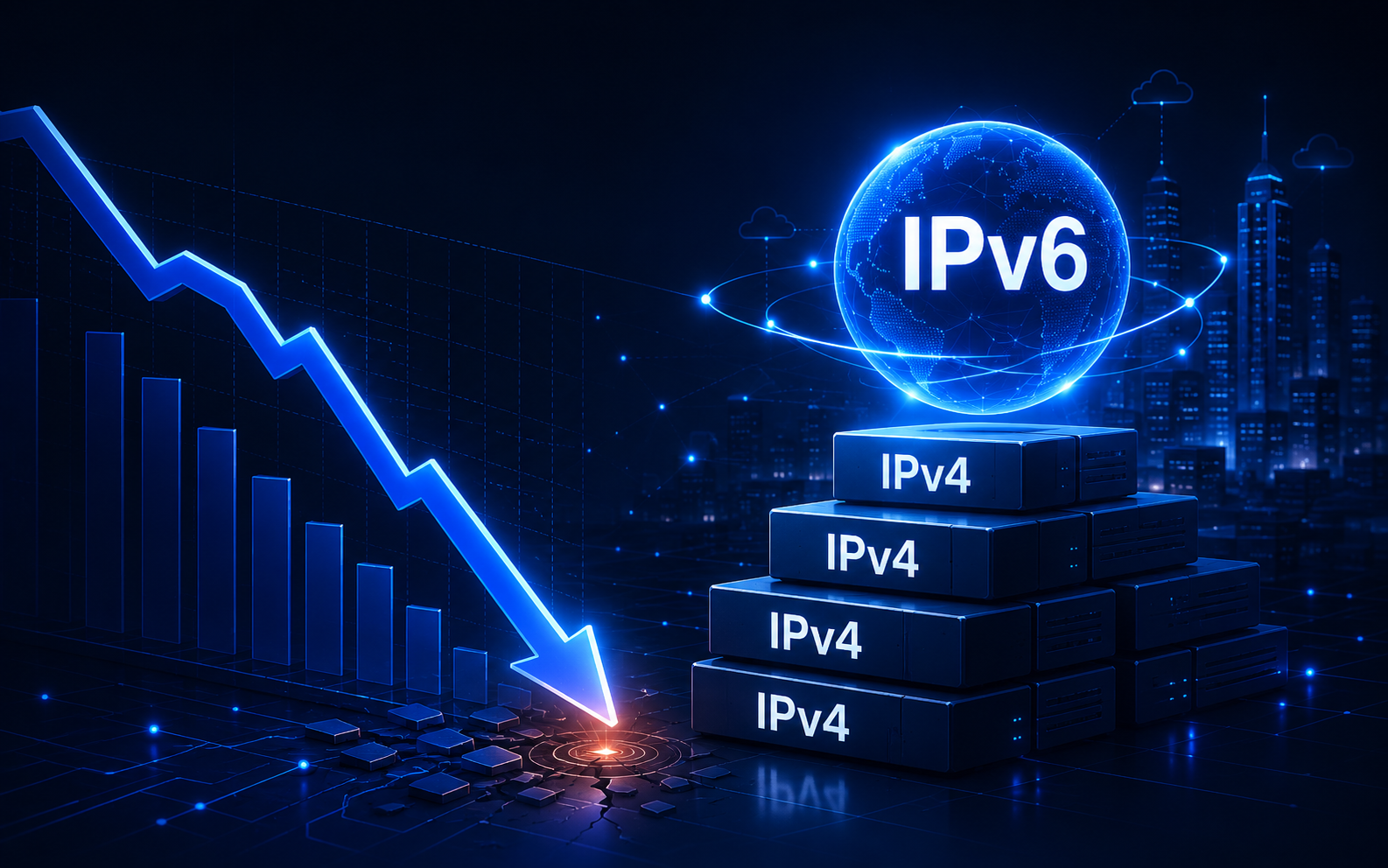
For years, the IPv4 address market felt like a never-ending bidding war. Scarcity looked permanent, prices above $50 per address no longer seemed unusual, and many buyers treated every available block as something to grab before someone else did.
Then 2025 changed the mood completely.
The market entered one of its sharpest corrections in more than a decade. Prices moved down, especially for larger blocks, while transfer activity remained strong. In other words, demand did not disappear. The market simply became more liquid, more selective, and far less emotional.
Key takeaways
- Large-block supply changed the pricing dynamic. /16 and larger blocks became more available, reducing the urgency premium.
- Buyers became more disciplined. Reputation, RIR region, transfer history, and clean provenance now matter more than raw scarcity.
- Leasing stayed resilient. Many operators now prefer flexible access over large upfront CAPEX.
- The market is not dying. It is maturing into a more rational, quality-driven IPv4 economy.
1. A supply surge killed the urgency premium
The biggest driver of the correction was the visible increase in large-block supply, especially /16 and larger allocations. When these lots started appearing more regularly, buyers no longer had to act as if every opportunity was their last.
The market shifted from a frantic auction environment to something much closer to a buyer’s market. There was more choice, more room for negotiation, and more time for proper due diligence.
The old mindset, “buy it now before it disappears,” has largely lost its power. In 2025, buyers started asking better questions: Where is the block registered? What is the abuse history? Is the geolocation clean? Are there blacklist issues? How smooth will the transfer be?
That shift matters. IPv4 is still scarce, but scarcity alone is no longer enough to justify panic pricing.
2. Technical workarounds are reducing pressure
Buying clean IPv4 addresses outright is no longer the only way to support growth. Operators have become more sophisticated, and several practical alternatives now reduce the pressure to overpay for ownership.
- CGNAT and proxy architectures help networks use existing IPv4 space more efficiently.
- IPv6-first deployment is becoming more realistic in environments where applications, users, and partners can support it.
- IPv4 leasing has become a practical option for public-facing endpoints, legacy systems, B2B integrations, reputation-sensitive hosting, iGaming, anti-fraud platforms, and other use cases where IPv4 is still required.
This does not mean IPv4 is becoming obsolete. Far from it. But demand is becoming more selective. Businesses still need IPv4 in specific operational scenarios, but many are no longer willing to pay a heavy ownership premium just to hold addresses forever.
3. The financial logic of ownership changed
In 2021–2023, holding IPv4 looked like a strong CAPEX decision. Prices were climbing, scarcity was the dominant story, and many organizations believed that buying addresses was safer than leasing them.
By 2025, that logic became much less straightforward.
| Segment | 2025 market behavior | What it means |
|---|---|---|
| Large blocks (/16+) | Sharpest price correction, with some reports showing multi-year lows and sub-$20/IP levels in 2025. | Buyers gained leverage, especially in larger transactions. |
| Smaller blocks (/24–/22) | Generally more resilient and more dependent on RIR region, reputation, and clean history. | Quality small blocks can still command a premium. |
| Leasing | Remained comparatively stable, often around the $0.38–$0.45/IP/month range depending on region and platform. | For many teams, leasing became the more flexible operating model. |
The result is a different kind of calculation. If a company buys IPv4 at a high per-address price, the break-even period against leasing can stretch for years. For teams that need flexibility, short-term capacity, or predictable operating expenses, leasing or hybrid models can make more sense than permanent ownership.
Ownership still has a place, especially for organizations with long-term infrastructure needs, stable routing requirements, and strict control over reputation. But it is no longer the automatic best answer.
4. 2026 outlook: quality over quantity
The most likely scenario for 2026 is not a collapse and not a return to the old boom. The more realistic outlook is stabilization with clear market bifurcation.
The premium segment
Clean blocks with strong reputation, accurate geolocation, good RIR positioning, low abuse history, and transparent transfer records should remain attractive. These assets may hold value better, especially when buyers need certainty and speed.
The commodity segment
Average-quality, large, or problematic blocks may continue to face pricing pressure. If a block carries reputation issues, unclear provenance, blacklist problems, or transfer complexity, buyers now have more alternatives and less reason to accept risk.
This is the real lesson of 2025: the market is no longer rewarding passive hoarding in the same way. The winners will be the players who add operational value.
- Fast and transparent transfers
- Clear provenance and ownership history
- Reputation checks and blacklist screening
- Flexible leasing and short-term options
- Support with RIR procedures, LOA, RPKI, reverse DNS, and routing documentation
Bottom line: IPv4 is not dead. Speculation is weaker.
The IPv4 “gold rush” is over, but the market is not dying. It is becoming more professional, more liquid, and more selective.
Demand remains healthy because many networks, platforms, and applications still depend on IPv4. At the same time, buyers are more careful, leasing is more accepted, and IPv6 is slowly changing the long-term planning picture.
If you are holding IPv4 addresses, the priority should be quality, documentation, and reputation. If you are buying or expanding, this may be one of the best windows in years to secure the resources you need without the panic pricing of the previous cycle.
The era of endless price increases is behind us. Welcome to the new, more rational IPv4 market.
Need a smarter IPv4 strategy for 2026?
Whether you are buying, selling, leasing, or evaluating your current IPv4 portfolio, InterLIR can help you understand market conditions, assess block quality, and choose the right model for your infrastructure needs.