





Executive Summary: What You Need to Know
🎯 Cloud service disruptions are business continuity events – not just technical problems. The AWS DynamoDB incident demonstrates how a single technical failure can cascade across multiple services, affecting business operations.
💰 Financial implications extend beyond downtime – Organizations face revenue loss from transaction failures, customer churn from service unavailability, and recovery costs that can exceed planned IT budgets.
🚀 Multi-region strategies are essential – Businesses that implemented cross-region redundancy maintained operations during the AWS outage, while those dependent on a single region experienced significant disruption.
⚠️ Hidden dependencies create unexpected vulnerabilities – Most organizations are unaware of the complex interdependencies between cloud services until an outage reveals them, often too late to mitigate impact.
Why Should Business Leaders Care About ‘Technical’ Cloud Disruptions?
Imagine arriving at your office to discover your company’s e-commerce platform is down, customer support tickets are piling up, and your team can’t deploy a critical security patch. Your CTO explains it’s due to “a DNS race condition in AWS DynamoDB that cascaded to EC2 and NLB services.” For most executives, this sounds like technical jargon that belongs in the IT department. But should it be?
In simple terms, cloud service disruptions are business continuity events that directly impact revenue, customer trust, and operational capability. They’re not just technical problems-they’re business problems that require strategic understanding and executive attention.
From my experience leading InterLIR, a specialized IPv4 marketplace, I’ve seen how infrastructure failures create immediate business impact. Services become unreachable. Transactions fail. Customer experience suffers.
The technical details matter less than understanding the business implications and having strategies to maintain operations.
The October 2025 AWS service disruption illustrates this perfectly. A race condition in DynamoDB’s DNS management system cascaded into a 15-hour disruption affecting thousands of businesses. Companies without proper resilience strategies faced significant consequences.
This guide breaks down cloud disruptions in business terms and provides a framework for smart resilience decisions. You don’t need to become a technical expert—just understand enough to ask the right questions.
How Do Cloud Services Fail, and What Makes These Failures Different from Traditional IT Outages?
Traditional IT outages typically affect a single system or location. When your company’s email server crashed in the past, it was an isolated incident with clear boundaries. Cloud service disruptions are fundamentally different-they’re more like a complex chain reaction that spreads unpredictably through interconnected systems.
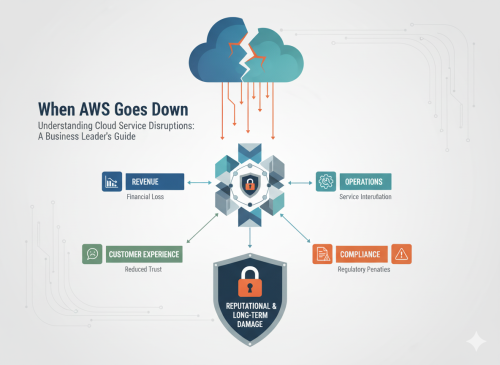
The Evolution of IT Infrastructure Failures
In the early days, infrastructure was simple. Each company had its own servers. When something failed, the impact was contained. You could see and touch your infrastructure—risks were tangible.
Today’s cloud infrastructure is different. It’s like a vast, interconnected city. Services are deeply interdependent, creating complex failure patterns that propagate unpredictably.
When one critical service fails, it can trigger cascades across seemingly unrelated systems—like a power outage affecting transportation, commerce, and communications throughout an entire city.
Anatomy of a Modern Cloud Failure
The AWS incident exemplifies this new reality. Let’s break down what happened in business terms:
- The Initial Failure – A race condition in DynamoDB’s DNS management system caused the service to become unreachable. Think of this as the main power station in our city analogy experiencing a critical failure.
- The Cascade Effect – This initial failure triggered problems in EC2 (compute services) and NLB (network load balancers), which depend on DynamoDB. In our city analogy, this is like the power outage causing traffic lights to fail, which then creates gridlock throughout the transportation system.
- The Recovery Challenge – Even after the initial DynamoDB issue was fixed, the secondary systems remained impaired due to backlogs and retry storms. This is similar to how traffic congestion persists long after traffic lights are restored.
What makes this particularly challenging is that most organizations were unaware of these dependencies until they experienced the impact. Many business leaders discovered critical vulnerabilities in their cloud architecture only after their services were already affected.
The Hidden Complexity of Cloud Dependencies
Cloud services hide complexity to make systems easier to use. This delivers benefits, but it also obscures the intricate web of dependencies that can affect your business.
| Traditional IT Failure | Cloud Service Disruption | Business Implication |
|---|---|---|
| Server hardware failure | DNS race condition triggering cascading service failures | What appears as a simple component failure can affect multiple business functions simultaneously |
| Network outage in your data center | Region-wide service degradation | Scale of impact is orders of magnitude larger |
| Clear ownership and control of recovery | Dependency on cloud provider’s recovery processes | Limited ability to directly influence resolution timeframes |
| Predictable impact on specific systems | Unpredictable propagation across services | Difficulty in assessing total business impact during an incident |
This fundamental difference requires a new approach to business continuity planning. The AWS incident demonstrates that technical architecture decisions have direct business implications that extend far beyond the IT department. Understanding these implications is now a core business leadership responsibility.
What Business Impacts Should Leaders Anticipate During Cloud Disruptions?
When cloud services fail, impacts extend far beyond “system downtime” or “error rates.” They translate directly into business consequences affecting revenue, customer experience, operational capability, and regulatory compliance.
Business impact flowchart showing how cloud disruptions affect revenue, operations, customer experience, and compliance
Immediate Revenue Impacts
During the AWS disruption, businesses experienced several direct revenue impacts:
💸 Transaction failures – E-commerce platforms dependent on DynamoDB for inventory or payment processing experienced failed transactions. One retail client reported losing approximately $150,000 in sales during a four-hour period when their checkout process was unavailable.
🔄 Subscription management disruptions – SaaS companies using affected services for subscription management faced challenges processing new subscriptions and renewals, creating revenue leakage.
📉 Marketing campaign ineffectiveness – Companies running time-sensitive promotions found their campaigns undermined when customers couldn’t complete purchases, wasting marketing spend and opportunity.
These impacts varied dramatically based on architecture choices. Companies with multi-region strategies maintained partial functionality. Those dependent on a single region faced complete disruption.
This demonstrates how technical architecture decisions directly influence business resilience and revenue protection.
Operational Capability Degradation
Beyond direct revenue impacts, the disruption affected organizations’ ability to operate effectively:
🚫 Deployment freezes – Organizations couldn’t launch new EC2 instances, forcing them to delay planned software releases and infrastructure scaling. One financial services company had to postpone a critical security patch deployment by 24 hours.
🔍 Monitoring blindness – Many companies lost visibility into their systems when monitoring tools dependent on affected services stopped functioning, hampering their ability to assess impact and respond effectively.
🧯 Incident response limitations – Technical teams found themselves unable to implement standard remediation procedures that required launching new resources or accessing affected services.
These operational impacts created secondary business consequences. The delayed security patch deployment, for example, created compliance exposure requiring disclosure to regulators.
Customer Experience Degradation
Perhaps the most significant business impact came through degraded customer experiences:
😠 Increased support volume – Companies reported support ticket volumes increasing by 300-500% during the disruption, overwhelming support teams and creating additional operational challenges.
🔁 Repetitive error experiences – Customers attempting to use services encountered frustrating error messages or spinning loading indicators, creating negative brand associations.
💔 Trust erosion – For services where reliability is a key value proposition (financial services, healthcare, critical business tools), the disruption damaged brand perception and trust.
Customer experience impact often lasted longer than the technical disruption itself. Customer confidence takes approximately 2-3 times longer to restore than the actual service.
This creates a “trust debt” that businesses must repay through consistent reliability after an incident.
The True Cost Calculation
When calculating the true business cost of cloud disruptions, leaders must consider multiple factors:
| Cost Category | Examples | Calculation Approach |
|---|---|---|
| Direct Revenue Loss | Failed transactions, subscription disruptions | Transaction volume × average value × disruption percentage |
| Operational Costs | Overtime, emergency response, recovery efforts | Additional labor hours × fully loaded cost |
| Customer Impact | Support surge, reputation damage, churn | Support volume increase × handling cost + estimated churn value |
| Opportunity Costs | Delayed launches, competitive disadvantage | Estimated value of delayed initiatives |
| Compliance Consequences | Regulatory reporting, potential penalties | Direct costs + risk-adjusted potential penalties |
This comprehensive view of business impact should inform both recovery priorities during an incident and investment decisions for resilience strategies. The organizations that weathered the AWS disruption most effectively were those that had previously conducted this analysis and invested accordingly.
How Can Organizations Build Practical Cloud Resilience Without Breaking the Budget?
Building cloud resilience isn’t just about implementing the most robust technical solutions-it’s about making strategic investments based on business priorities. The AWS incident provides valuable insights into effective approaches that balance cost with protection.
The Resilience Spectrum: From Basic to Advanced
Cloud resilience exists on a spectrum, with different approaches offering varying levels of protection at different cost points:
🔹 Basic resilience – Focused on recovery rather than continuity, this approach accepts some downtime but ensures data is protected and services can be restored. This is appropriate for non-critical business functions.
🔶 Enhanced resilience – Implements redundancy within a region and basic cross-region capabilities for the most critical components. This approach can maintain core functionality during many types of disruptions.
🔷 Advanced resilience – Employs active-active multi-region architectures with automated failover. This approach maintains near-continuous operations but at significantly higher cost and complexity.
During the AWS incident, organizations across this spectrum experienced dramatically different outcomes. Those with basic resilience faced complete disruption. Those with advanced resilience maintained operations with minimal impact.
The key insight: targeted resilience—applying the right level of protection to each business function based on its criticality—delivered the best return on investment.
Strategic Approaches to Cloud Resilience
Based on the AWS incident and our experience at InterLIR working with organizations managing critical network resources, I recommend these strategic approaches:
- Business function prioritization – Categorize your business functions by criticality, considering both revenue impact and customer experience. This creates a clear framework for resilience investment decisions.
- Dependency mapping – Identify the complete chain of cloud service dependencies for each critical business function. The AWS incident demonstrated how hidden dependencies can undermine resilience strategies.
- Targeted multi-region implementation – Apply multi-region architectures to your most critical functions first. During the AWS incident, even partial multi-region implementation provided significant protection.
- Graceful degradation design – Engineer systems to maintain core functionality even when some components are unavailable. This approach delivered substantial business protection at moderate cost.
- Regular resilience testing – Validate your resilience strategies through controlled testing. Organizations that had previously tested regional failure scenarios responded more effectively during the actual incident.
This strategic approach achieves meaningful resilience without the prohibitive cost of advanced protection for all systems.
It’s about making smart investments based on business priorities.
Cost-Effective Resilience Patterns
Several specific technical patterns proved particularly effective during the AWS incident while maintaining reasonable cost profiles:
💡 Read replicas across regions – Organizations that replicated read-only data across regions maintained the ability to retrieve information even when write operations were impacted. This pattern costs significantly less than full active-active implementations while preserving critical capabilities.
💡 Static fallbacks – Services that implemented static fallback content maintained basic customer experiences during the disruption. This simple pattern delivered substantial brand protection at minimal cost.
💡 Circuit breakers and bulkheads – Systems designed to isolate failures prevented the cascade effect that amplified the AWS disruption. These architectural patterns add minimal cost while significantly improving resilience.
💡 Asynchronous processing – Organizations that designed systems to queue operations for later processing maintained functionality during the disruption and recovered more quickly afterward.
These patterns don’t require duplicating entire infrastructures across regions. Instead, they focus on maintaining critical capabilities through targeted resilience strategies.
This approach delivers substantial business protection at a fraction of the cost of full redundancy.
What Questions Should Leaders Ask Their Technical Teams About Cloud Resilience?
As a business leader, you don’t need to understand every technical detail. But you do need to ask the right questions to ensure your organization is protected.
The AWS incident highlights critical areas of inquiry that help assess your cloud resilience posture and make informed decisions about risk management and resource allocation.
Frequently Asked Questions
How long do cloud service disruptions typically last?
Cloud service disruptions can vary significantly in duration. The AWS DynamoDB incident lasted approximately 15 hours, but impacts can extend well beyond the initial technical resolution due to cascading effects, retry storms, and recovery backlogs. Most major cloud providers aim for 99.99% uptime, but even brief disruptions can cause significant business impact depending on your architecture.
What’s the difference between multi-region and multi-availability zone redundancy?
Multi-availability zone (AZ) redundancy protects against failures within a single data center or region, while multi-region redundancy protects against entire regional outages. During the AWS incident, multi-AZ setups within the affected region still experienced disruption, while multi-region architectures maintained operations. For critical business functions, multi-region strategies provide the highest level of protection.
How much does implementing cloud resilience cost?
Cloud resilience costs vary based on your approach. Basic resilience (backup and recovery) adds minimal cost. Enhanced resilience with targeted multi-region capabilities typically increases infrastructure costs by 20-40%. Advanced active-active multi-region architectures can double costs but provide near-continuous operations. The key is matching resilience investment to business criticality—not every system needs the highest level of protection.
Can I rely on cloud provider SLAs for protection?
While cloud provider SLAs provide service level guarantees, they typically offer credits rather than preventing business impact. During the AWS incident, affected customers received service credits, but these rarely compensate for actual business losses including revenue, customer churn, and operational disruption. SLAs are important, but they shouldn’t be your primary resilience strategy.
How do I identify hidden dependencies in my cloud architecture?
Hidden dependencies are one of the biggest challenges in cloud resilience. Start by mapping your critical business functions to their underlying cloud services, then trace dependencies through each service layer. Use cloud provider dependency mapping tools, conduct regular architecture reviews, and test failure scenarios. Many organizations discover critical dependencies only during actual incidents—proactive discovery is essential.
What should I prioritize when building cloud resilience?
Prioritize based on business impact: revenue-generating functions, customer-facing services, and compliance-critical systems should receive the highest resilience investment. Start with dependency mapping, then implement multi-region strategies for your most critical functions. Design for graceful degradation so systems maintain core functionality even when some components fail. Regular testing and validation are essential—resilience strategies that aren’t tested may not work when needed.