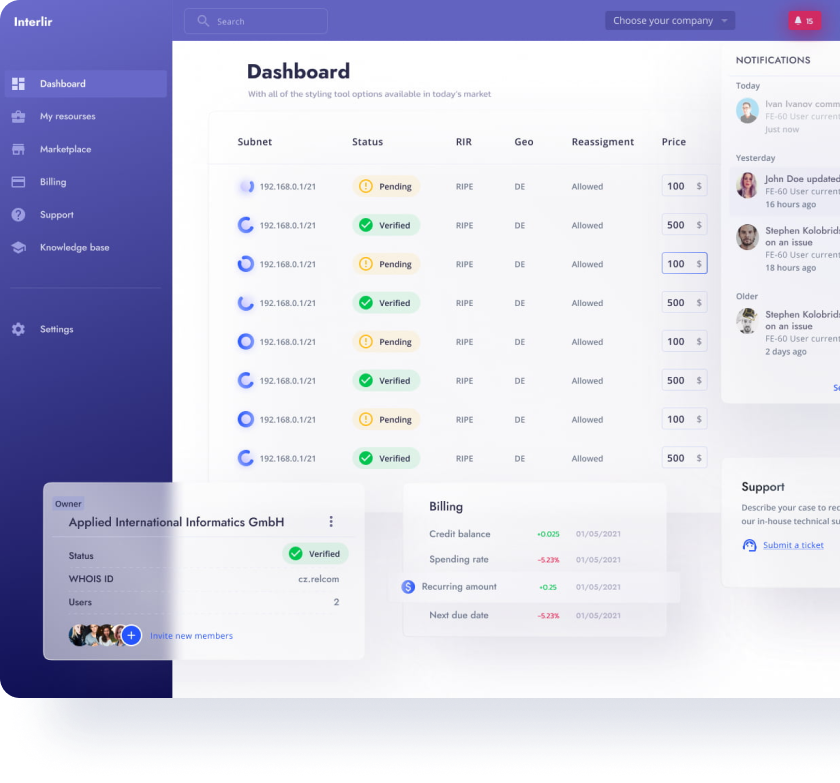
IPv4 operations become risky when orders, assignments, routing data, and reverse DNS are handled in separate tickets or spreadsheets. An API-first model makes the address lifecycle traceable and repeatable from request to deployment.
API IP assignment is the automated allocation of IPv4 addresses or subnets through a controlled interface. It supports IPv4 provisioning, automated management, rDNS assignments, and IPAM updates by connecting ordering, approval, routing, DNS, billing, and monitoring into one auditable workflow.
API-first management means that every change starts from a defined endpoint, not from a manual edit. A request can reserve a subnet, assign an address, update owner data, create rDNS, and notify monitoring. The system should still require approval for high-risk actions.
A typical workflow includes:
This model helps DevOps and network teams use the same source of truth. It also lowers the chance of duplicate assignment or missing records.
To automate block allocation, the platform must know which IPv4 ranges are available, which are reserved, and which are already active. It must also understand size, region, reputation, RIR status, and allowed use case.
The control layer should validate:
This is why an API-first IPAM solution should not only return an address. It should return the operational context that makes the address safe to use.
LIR integration connects the internal platform with registry, broker, or resource-holder workflows. It helps teams keep WHOIS/RDAP, ROA, IRR, rDNS delegation, and contract data aligned with real usage.
For leased ranges, the workflow should record who controls the resource and who can update authorization. Teams that lease IPv4 addresses should define these roles before production. If a block becomes permanent infrastructure, teams can compare lease automation with Buy IPv4 Addresses.
The key point is consistency. The router, registry, DNS, IPAM, and contract should describe the same resource.
Reverse DNS is often treated as a small task, but it can affect mail delivery, logging, security review, and customer trust. rDNS assignments should follow naming rules, approval policy, and zone delegation rules.
A safe rDNS workflow should check:
For smaller subnets, delegation can be more complex than a simple /24 boundary. The API should show whether the request creates a PTR record, a zone delegation, or a ticket for manual review.
A B2B automation endpoint is useful when customers, resellers, or internal platforms need repeatable actions. It can expose order status, available blocks, assignment state, rDNS requests, lease dates, and abuse contacts.
Useful endpoint groups include:
The endpoint should use authentication, rate limits, role-based access, audit logs, and idempotency keys. Without these controls, automation can create fast mistakes.
Engineering teams should treat IPv4 automation like production infrastructure. A bad API call can assign the wrong block, overwrite rDNS, expose a customer service, or remove a monitoring dependency.
Important controls include change approval, dry-run mode, schema validation, permission boundaries, rollback, and alerting. Each automated action should create a record that humans can review during an audit or incident.
Can API automation replace network approval?
No. It can automate routine steps, but high-risk changes still need policy checks and approval.
Should rDNS be automated for every address?
Not always. Standard PTR changes can be automated, while delegated zones or sensitive names may need review.
What is the main benefit of API-based provisioning?
It creates consistent records across IPAM, DNS, routing, billing, and monitoring.
What is the main risk of IPv4 automation?
The main risk is fast propagation of a wrong change. Validation, rollback, and audit logs are required.
If your team needs IPv4 space for automated provisioning, order workflows, rDNS operations, or IPAM-driven lifecycle control, contact InterLIR. The company provides infrastructure for IPv4 leasing, buying, lease-out, and marketplace workflows, so businesses can connect address resources with automation, routing, and operational governance.

Evgeny Sevastyanov
Support Team Leader

A Beginner’s Guide to Subnetting IPv4 and IPv6 Addresses Subnetting is a critical

Why IPv4 Leasing Is Becoming the Smart Choice for Businesses in 2025 1. Introduction
As CEO of InterLIR, I’ve witnessed firsthand how network isolation strategies

What is an ASN? ASN stands for Autonomous System Number. It is a unique identifier

Anycast DNS: A Leader’s Guide to Protecting Your Digital Infrastructure Executive

RPKI Certification: A Leader’s Guide to Internet Routing Security Executive

Executive Summary: What You Need to Know 🎯 Strategic Importance – Internet

When AWS DynamoDB failed in October 2025, thousands of businesses discovered that

Executive Summary: What You Need to Know 🎯 IP reputation directly impacts your
Live chat is provided by Intercom and is loaded only after you enable it. You can also contact us without enabling the chat.