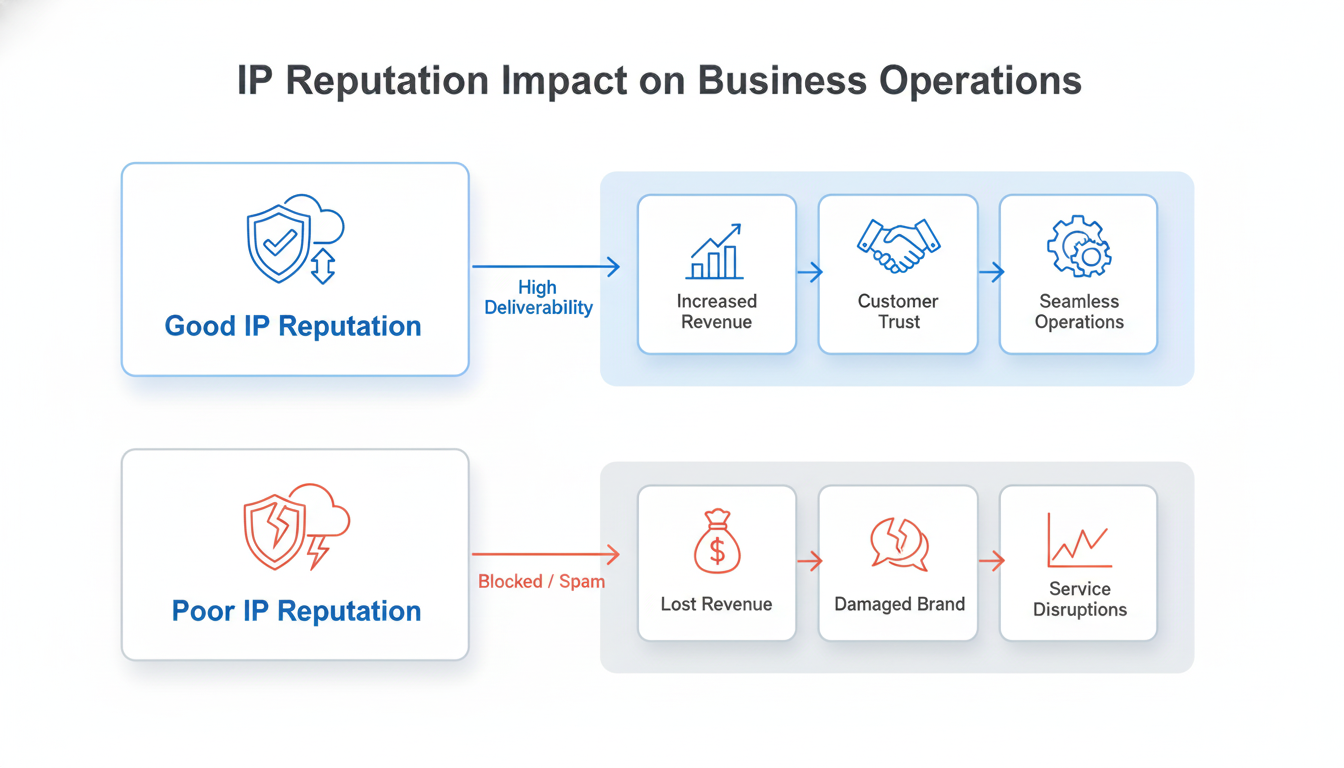
🎯 IP reputation directly impacts your business operations – Poor IP reputation can block email deliverability, limit access to critical services, and damage customer trust
💰 Financial implications are significant – Organizations with compromised IP addresses face increased operational costs, lost revenue from service disruptions, and expensive remediation processes
🚀 Proactive management is essential – Implementing monitoring systems, regular security audits, and clear incident response protocols can prevent most reputation issues before they impact operations
⚠️ Spam remains the #1 threat – Despite technological advances, spam continues to be the primary abuse vector affecting IP reputation across all industries
Imagine arriving at an important client meeting only to discover your company emails have been landing in spam folders for weeks. Your sales team missed crucial opportunities, customer support inquiries went unanswered, and your marketing campaigns generated zero results despite significant investment. This scenario plays out daily for businesses that neglect their IP address reputation.
In simple terms, IP reputation is like your business’s digital credit score. Just as a poor credit rating limits your financial options, a damaged IP reputation restricts your ability to communicate, conduct transactions, and maintain customer trust in the digital realm. It’s not just a technical concern-it’s a fundamental business asset that directly impacts your bottom line.
The digital landscape has evolved dramatically since I began working in IP management eight years ago. What was once a niche technical concern has become a critical business priority. With the increasing scarcity of IPv4 addresses (the internet’s primary addressing system) and the growing sophistication of spam detection systems, maintaining clean IP reputation has transformed from an IT department responsibility into a strategic business imperative.
In my role at InterLIR, I’ve witnessed firsthand how IP reputation issues can paralyze operations across organizations of all sizes. From multinational corporations to emerging startups, the inability to send emails, access critical services, or maintain customer trust due to IP reputation problems creates immediate and costly business disruptions.
In this guide, I will break down what IP reputation is in simple terms, explain why managing it correctly is critical for your business, and provide a clear roadmap for making smart decisions about this increasingly valuable digital asset. Let’s start by understanding how these digital identifiers became so important in the first place.
To understand the current landscape, let me take you back to the early days of the internet. In the 1980s and early 1990s, IP addresses were abundant resources, freely distributed to organizations that requested them. Think of it like the early days of a small town, where land was plentiful and available to anyone willing to develop it.
As the internet exploded in popularity throughout the 1990s and 2000s, something fundamental changed. The original addressing system, IPv4, was designed with approximately 4.3 billion possible addresses. This seemed inexhaustible at the time, but no one anticipated the explosive growth of internet-connected devices. Suddenly, what had been an abundant resource became increasingly scarce.
I often explain this transformation to clients using a real estate analogy. Imagine a rapidly growing city where all the land has been claimed, yet more people arrive daily needing space. In the IP address world, we reached this critical point in 2011 when IANA (the Internet Assigned Numbers Authority) allocated the last blocks of unused IPv4 addresses to regional registries.
This shift from abundance to scarcity created a high-stakes market with significant implications for businesses. IP addresses transformed from simple technical resources into valuable digital assets with real financial value. At InterLIR, we’ve seen IPv4 addresses appreciate considerably in value, with prices increasing from around $15 per address in 2018 to between $27-50 per address in 2024, depending on block size and region.
As IP addresses became valuable assets, another critical development occurred: the rise of reputation-based filtering systems. Email providers and network security companies began tracking the behavior associated with IP addresses to combat the growing problem of spam and malicious activities.
This created a new dimension of value beyond mere scarcity. An IP address with a clean reputation became significantly more valuable than one with a history of suspicious activity. I’ve worked with clients who discovered too late that the IP addresses they acquired had previously been used for spam campaigns, rendering them practically unusable for legitimate business purposes.
The combination of physical scarcity and the importance of reputation created a complex market dynamic that continues today. Organizations now face dual challenges: securing the IP addresses they need while ensuring those addresses maintain pristine reputations that allow unhindered business operations.
Based on my experience managing thousands of IP addresses at InterLIR, I’ve found that effective reputation management requires a structured approach combining proactive monitoring, preventative measures, and clear incident response procedures. Let me break this down into a practical framework.
Before you can protect your IP reputation, you need to understand its current status. Just as you would check your credit report before applying for a loan, you should regularly assess how your IP addresses are perceived across the internet.
At InterLIR, we conduct comprehensive reputation checks for all IP addresses in our marketplace. This process involves checking multiple reputation databases and blocklists to ensure addresses are clean before they’re made available to clients. You should implement a similar process for your organization’s IP resources.
1️⃣ Identify All Your IP Assets – Create a complete inventory of all IP addresses used by your organization, including those assigned to cloud services, email servers, and other digital infrastructure
2️⃣ Check Major Blocklists – Verify your IP addresses against major blocklists like Spamhaus, Barracuda, SORBS, and SpamCop
3️⃣ Assess Sender Scores – For email-sending IPs, check sender reputation scores through services like Sender Score, Google Postmaster Tools, or Microsoft SNDS
4️⃣ Document Baseline Status – Create a central repository documenting the current reputation status of all your IP addresses
5️⃣ Establish Monitoring Schedule – Determine how frequently you’ll check reputation (daily for critical services, weekly for others)
Once you understand your current reputation status, the next step is implementing systems to prevent reputation damage. In my experience, prevention is significantly less expensive and disruptive than remediation.
🔒 Secure Authentication Systems – Implement strong authentication for all systems that can send outbound traffic from your IP addresses to prevent unauthorized use
📊 Traffic Monitoring – Deploy systems that analyze outbound traffic patterns to identify anomalies that might indicate compromise
🚫 Rate Limiting – Implement rate limits on outbound communications, especially email, to prevent mass spamming if systems are compromised
📧 Email Authentication – Configure SPF, DKIM, and DMARC records to prevent email spoofing from your domains
🔍 Regular Security Audits – Conduct periodic assessments of your IP infrastructure to identify potential vulnerabilities
At InterLIR, we’ve found that implementing these preventative measures reduces abuse incidents by approximately 30%, saving significant time and resources that would otherwise be spent on remediation.
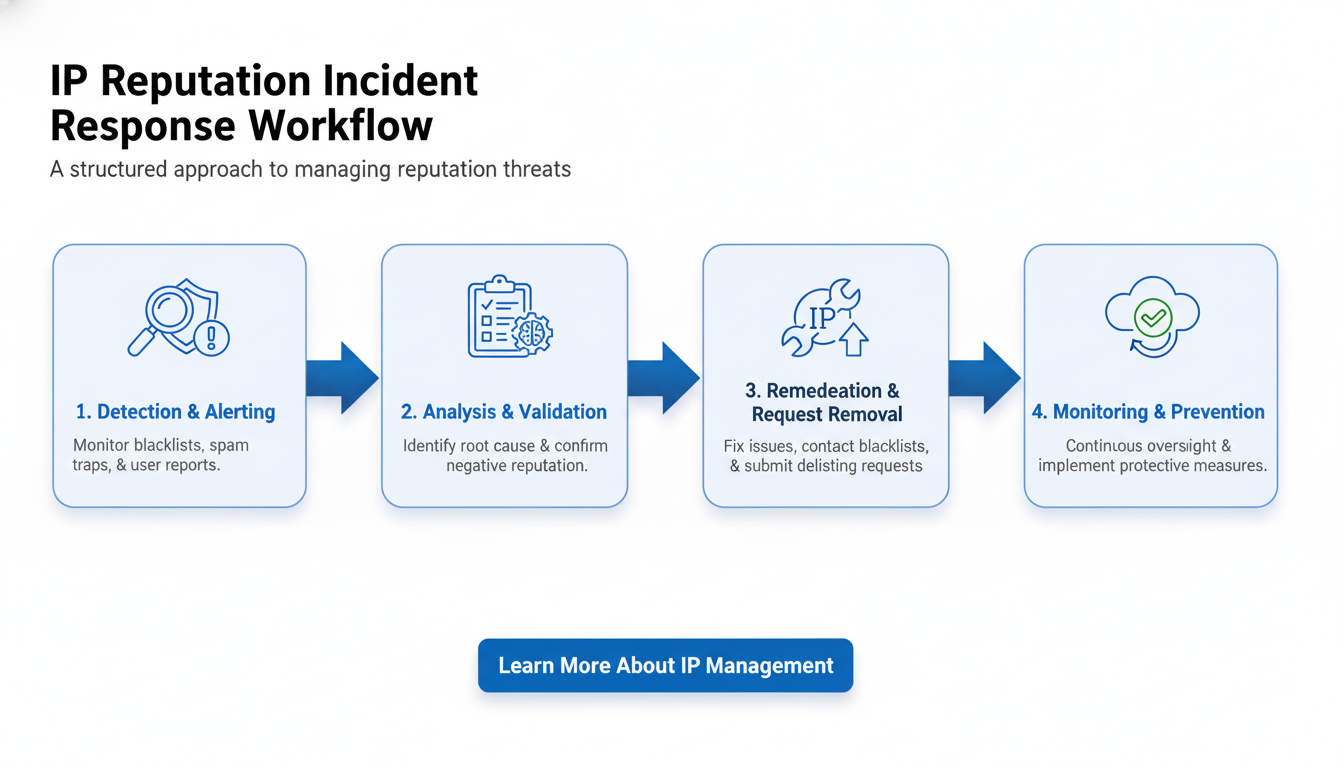
Despite best preventative efforts, reputation incidents can still occur. Having a clear, documented response plan is crucial for minimizing impact and quickly restoring normal operations.
| Response Phase | Key Actions | Responsible Team |
|---|---|---|
| Detection | Monitor blocklists and reputation scores, receive abuse reports | Security Operations |
| Assessment | Determine affected IPs, identify abuse type, evaluate business impact | Security & Business Operations |
| Containment | Isolate affected systems, implement temporary blocks if necessary | IT Infrastructure |
| Remediation | Address root cause (malware removal, fixing vulnerabilities) | Security & IT Teams |
| Recovery | Request delisting from blocklists, restore normal operations | Compliance & Operations |
| Documentation | Record incident details, update procedures to prevent recurrence | All Teams |
The speed of your response directly impacts how quickly your IP reputation can recover. In my experience managing abuse cases at InterLIR, incidents addressed within 24 hours typically see reputation recovery within 3-5 days, while delayed responses can extend recovery time to weeks or even months.
When discussing IP reputation with business leaders, I often encounter the misconception that this is merely a technical issue with limited business impact. Let me be clear: IP reputation problems directly affect your bottom line through multiple channels.
💸 Lost Revenue from Communication Failures – When your emails land in spam folders or are blocked entirely, you lose direct communication with customers, prospects, and partners. One client discovered their sales team’s outreach emails had a 70% lower delivery rate due to IP reputation issues, directly impacting their pipeline
🔥 Brand Damage from Security Incidents – IP addresses associated with your brand that engage in suspicious activities (even unintentionally) damage customer trust. According to research, 87% of consumers will hesitate to do business with a company that has experienced a security breach
📉 Wasted Marketing Investment – Marketing campaigns relying on email or web-based communication channels fail to reach their audience when IP reputation issues exist. One e-commerce client estimated a loss of €45,000 in a single campaign due to delivery problems
⏱️ Operational Disruption and Recovery Costs – When critical IP addresses are blocklisted, IT teams must divert from planned projects to emergency remediation. The average cost of IP reputation remediation for a mid-sized business can exceed $10,000 in direct costs and lost productivity
Let me share a real example that illustrates these costs. A mid-sized software company acquired a block of IP addresses from a third-party broker without conducting proper reputation due diligence. Unknown to them, these addresses had previously been used for spam campaigns and were listed on several major blocklists.
After configuring their new infrastructure using these addresses, they launched a major product update announcement to their customer base of approximately 15,000 users. Due to the poor reputation of their newly acquired IP addresses, over 60% of these critical communications were blocked or filtered to spam folders.
The consequences were severe and immediate:
🚫 Customer Support Crisis – Their support team was overwhelmed with calls from customers who hadn’t received update instructions
💻 Failed Update Deployment – Many customers continued using the outdated version, creating security vulnerabilities and compatibility issues
💰 Emergency Remediation Costs – They had to engage a specialized consultant to address the blocklisting issues at a cost of $15,000
⏰ Extended Recovery Timeline – It took nearly three weeks to fully restore their IP reputation, during which time their communication capabilities remained compromised
The total estimated cost of this incident, including remediation expenses, lost productivity, and damaged customer relationships, exceeded $75,000. All of this could have been prevented with proper IP reputation verification before acquisition-a service that would have cost less than $1,000.
When I consult with business leaders about IP management, I emphasize that investing in proper IP reputation management isn’t an IT expense-it’s business insurance that protects revenue streams, marketing investments, and customer relationships. The return on investment becomes clear when you consider the potential costs of reputation incidents.
At InterLIR, we’ve found that organizations implementing comprehensive IP reputation management typically spend 5-7% of what they would incur in a significant reputation incident. This preventative approach not only reduces risk but also provides operational stability that supports business growth and customer trust.
Based on my experience managing IP resources for diverse organizations, I’ve identified several strategic approaches that business leaders should consider implementing in 2024 and beyond.
🔮 AI-Powered Reputation Systems – Major email providers and security companies are increasingly deploying sophisticated AI systems to evaluate IP reputation. These systems analyze behavioral patterns rather than simply checking static blocklists, making reputation management more complex but potentially more accurate
🔧 Reputation Data Consolidation – We’re seeing increased sharing of reputation data between previously siloed systems. An IP address flagged by one provider is more quickly recognized by others, accelerating both the spread of negative reputation and the benefits of positive reputation
📈 Rising Value of Clean IP Addresses – As IPv4 scarcity continues and reputation systems become more sophisticated, the market value of addresses with pristine reputations continues to increase. At InterLIR, we’ve observed premium pricing for addresses with established positive history

Nikita Sinitsyn
Customer Service Specialist
🎯 IP reputation directly impacts your business operations – Poor IP reputation can block email deliverability, limit access to critical services, and damage customer trust
💰 Financial implications are significant – Organizations with compromised IP addresses face increased operational costs, lost revenue from service disruptions, and expensive remediation processes
🚀 Proactive management is essential – Implementing monitoring systems, regular security audits, and clear incident response protocols can prevent most reputation issues before they impact operations
⚠️ Spam remains the #1 threat – Despite technological advances, spam continues to be the primary abuse vector affecting IP reputation across all industries

A Beginner’s Guide to Subnetting IPv4 and IPv6 Addresses Subnetting is a critical

Why IPv4 Leasing Is Becoming the Smart Choice for Businesses in 2025 1. Introduction
As CEO of InterLIR, I’ve witnessed firsthand how network isolation strategies

What is an ASN? ASN stands for Autonomous System Number. It is a unique identifier

Anycast DNS: A Leader’s Guide to Protecting Your Digital Infrastructure Executive

RPKI Certification: A Leader’s Guide to Internet Routing Security Executive

Executive Summary: What You Need to Know 🎯 Strategic Importance – Internet

When AWS DynamoDB failed in October 2025, thousands of businesses discovered that

Executive Summary: What You Need to Know 🎯 IP reputation directly impacts your
Live chat is provided by Intercom and is loaded only after you enable it. You can also contact us without enabling the chat.