Acquired IPv4 reputation can determine whether a leased or purchased IP block is ready for production. Every prefix carries operational history: previous routing, outdated geolocation data, blacklist exposure, abuse reports and reputation signals.
For companies leasing, buying or transferring IPv4 resources, these hidden factors can affect email deliverability, user access, fraud checks, compliance reviews and infrastructure reliability.
The global shortage of IPv4 addresses has created an active secondary market. Companies lease, buy and transfer IPv4 blocks to support hosting, cloud infrastructure, SaaS platforms, email systems, VPN services, CDN deployments and other internet-facing services.
At first glance, acquiring IPv4 space may look like a straightforward process: verify the seller or lessor, receive a Letter of Authorization, update WHOIS or RDAP records, configure routing and start using the addresses.
In practice, an IPv4 block is not a blank technical asset. Previous routing, outdated geolocation data, DNSBL listings, abuse reports and poor IP reputation can follow the block after a transfer or lease.
Quick answer: the main hidden costs of acquired IPv4 are geolocation mismatch, blacklist exposure and reputation debt. These issues can disrupt access to online services, reduce email deliverability, trigger fraud filters and increase support workload after deployment.
Acquired IPv4 reputation is the combined effect of a prefix’s previous use, abuse history, blacklist status, geolocation records and routing background. Even when ownership or leasing documentation is correct, the wider internet may still evaluate the block based on its past.
This is why IPv4 acquisition should not be treated only as a pricing decision. Whether a company leases IPv4 addresses, buys a prefix for long-term use or prepares address space for customer-facing infrastructure, it needs a proper technical and reputation check before production traffic starts.
IPv4 geolocation may remain outdated for weeks or months after a prefix moves to a new country, network or provider.
Geofeeds give geolocation providers a structured source of prefix-to-location information.
Transferred or leased IP space may inherit abuse history, blacklist records or poor email reputation.
RPKI/ROA, route objects and proper authorization help reduce routing and onboarding risks.
In this article, acquired IPv4 means any IPv4 address space that an organization starts using after it was previously controlled, routed or used by another party.
The commercial status of the block may change quickly, but the internet ecosystem does not update instantly. Geolocation databases, mail filters, security platforms, fraud systems and reputation tools may continue to treat the addresses according to their previous history.
This matters for companies using IPv4 space for real infrastructure. A prefix can be technically routed correctly and still cause business problems if banks, SaaS platforms, streaming services, mail providers or fraud prevention systems classify it incorrectly.
IP geolocation databases do not work like GPS. They estimate location from a combination of signals, including WHOIS and RDAP records, routing data, traceroutes, user-submitted corrections, commercial datasets and geofeeds.
When a prefix is reallocated, transferred or announced from a new network, it may be operationally used in one country while still being listed in another country by major geolocation providers.
This creates an IPv4 geolocation mismatch: the network operator expects the block to be treated as one location, while websites, applications and security systems see a different location.
The problem becomes more visible in the IPv4 secondary market because prefixes move more often. A block that was previously routed in one region may later be leased to a customer in another region, transferred to a new holder or used by a different infrastructure provider.
For example, a company may lease a /24 for infrastructure in Germany, but parts of the internet may still classify the range as being located in another country. From the customer’s point of view, the service may look broken even though the routing is technically correct.
Geolocation accuracy is especially important when IPv4 space is leased, purchased or transferred from another organization. The new user may receive valid technical documentation, but the wider internet may still associate the prefix with its previous location, previous routing history or previous abuse patterns.
This creates a gap between legal control and operational readiness. A company may be fully authorized to use a block, but still face problems with incorrect geolocation, DNSBL listings, outdated route objects, missing ROAs or poor reputation signals.
A leased prefix should be checked before customer traffic starts. Price matters, but routing readiness, geolocation accuracy and reputation history often matter more in production.
A purchased block can become a long-term asset, but only if the buyer understands its previous use, abuse history, registry status and operational condition.
Owners leasing out unused IPv4 space should keep documentation, route authorization and abuse handling clean to protect long-term asset value.
For businesses that depend on stable infrastructure, these issues can affect more than network configuration. They can influence customer access, email deliverability, fraud checks, compliance reviews and support workload.
A geofeed is a standardized CSV file that maps IP prefixes to geographic information such as country, region and city. The format is described in RFC 8805.
Instead of forcing every geolocation provider to infer location indirectly, a geofeed lets a network operator publish a structured declaration of where prefixes should be geolocated.
Example geofeed entry
203.0.113.0/24,DE,DE-BE,Berlin,The exact data should match the operational reality of the network. For privacy and accuracy reasons, geofeeds should describe infrastructure or user groups at an appropriate level, not expose overly precise information about individual users.
Geolocation providers receive a clear and structured source instead of relying only on inference.
Fewer users are blocked or misclassified because of stale location data.
The resource holder can maintain location data as prefixes are reassigned.
Newly leased, transferred or acquired IPv4 space can be prepared before production traffic begins.
For operators managing many IPv4 ranges, geofeeds should be part of the normal provisioning workflow. Whenever a prefix is leased, moved, transferred or reassigned, the geofeed should be reviewed and updated.
Publishing a geofeed is useful, but consumers also need to know that the file is legitimate. RFC 9632 describes how geofeed data can be discovered and how it can optionally be authenticated using RPKI.
A signed geofeed helps prove that the location information was published by the legitimate resource holder or an authorized party. This matters because incorrect geolocation data can affect access control, fraud systems, digital services and user trust.
Important: RPKI does not define IP geolocation by itself. RPKI helps validate routing authorization. Signed geofeeds use resource ownership signals to make geolocation data more verifiable.
Signed geofeeds are especially relevant for IPv4 leasing providers, hosting operators, networks with frequent customer reallocations and companies operating infrastructure across several countries.
Geofeeds do not guarantee instant correction across every provider. Each geolocation database has its own update process. Still, publishing a correct geofeed gives providers a clear, machine-readable source and reduces the time spent on manual correction requests.
For companies that lease or buy IPv4 resources, geofeeds should be combined with routing security. InterLIR explains the practical role of RPKI in IPv4 leasing and BGP security in its article What Is RPKI and Why It Matters for IPv4 Leasing, BYOIP, and BGP Security.
Geolocation is only one side of the problem. The second hidden cost is IP reputation debt.
IP reputation debt means the negative operational history attached to an IP range before the new owner or lessee starts using it. This can include spam, phishing, malware hosting, botnet activity, bulletproof hosting, scanning, abusive proxy activity or previous route hijacking incidents.
DNS-based blocklists and reputation systems track IP addresses and ranges associated with abuse. When an IPv4 block changes hands, its legal or commercial ownership may change, but reputation systems may still remember the previous behavior. A clean transfer document does not automatically erase blacklist history.
Messages may be rejected, throttled or routed to spam.
Firewalls and security platforms may block or challenge traffic.
Users may see warnings, failed logins or unusual verification prompts.
Delisting and remediation may take days or weeks.
Not every listing has the same meaning. Some lists indicate direct abuse. Others are policy-based, for example dynamic residential ranges that should not send mail directly. Some listings expire automatically after the activity stops, while others require manual delisting and evidence of remediation.
This is why reputation checks should be done before purchase, lease or production onboarding.
Transferred or leased IPv4 space should never be assumed clean without verification. The risk varies by prefix, region, previous user and intended use case, but the operational lesson is simple: a block’s past can affect its future value.
For IPv4 buyers and lessees, this means that price per IP is only one part of the real cost. A cheaper block can become expensive if it requires urgent delisting, repeated geolocation correction, customer support escalation or onboarding delays.
The best time to identify hidden IPv4 costs is before the block is used in production. A structured due diligence process should cover ownership, authorization, routing, geolocation and abuse history.
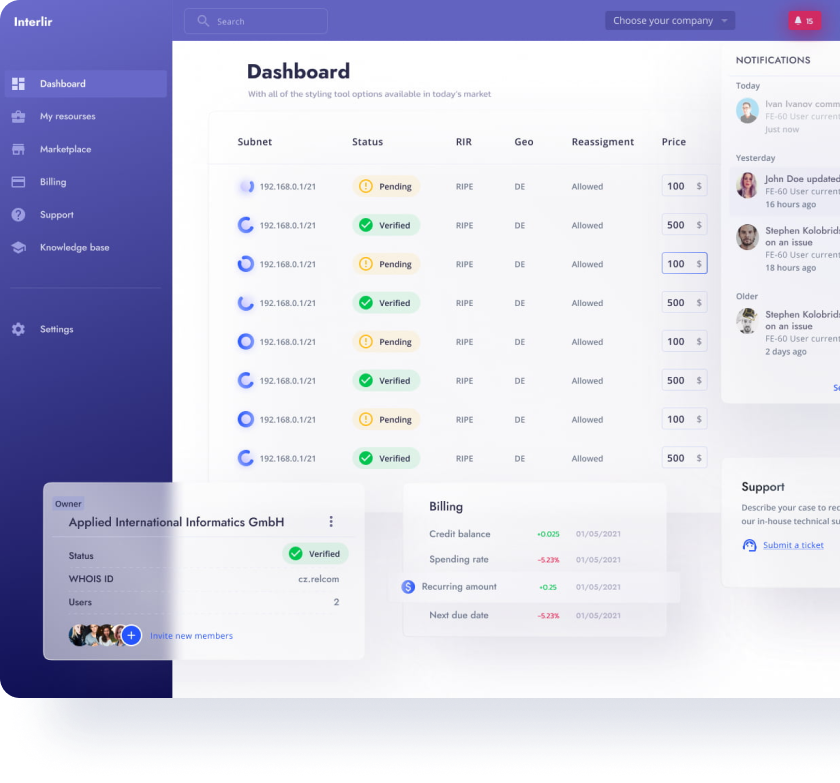
InterLIR is an IPv4 marketplace for companies that need to lease, buy, sell or monetize IPv4 resources. But the value of an IPv4 block is not limited to its price or availability. The block also needs to be operationally ready.
That means checking authorization, routing records, geolocation consistency and reputation risks before the prefix is used in production.
For companies leasing or acquiring IPv4 space, InterLIR helps reduce the operational friction that often appears after the transaction:
Companies can access available IPv4 blocks through a structured marketplace model instead of relying on informal or poorly documented arrangements.
Proper LOA handling, WHOIS/RDAP checks and resource-holder verification help reduce onboarding delays and ownership confusion.
Route objects, RPKI/ROA and origin ASN checks help ensure the prefix is technically ready for announcement.
Geolocation review and correction workflows help reduce wrong-country classification and related customer-facing issues.
Blacklist and abuse-history awareness helps customers avoid assigning problematic address space to sensitive workloads too quickly.
A more structured IPv4 process reduces the chance that hidden issues appear only after production traffic starts.
For companies that need IPv4 space quickly, InterLIR IPv4 leasing provides access to available IPv4 blocks through a marketplace model. For IP resource holders, leasing out IPv4 addresses through InterLIR can turn unused IPv4 space into recurring revenue while keeping the process organized.
If an acquired or leased prefix will later be used in a cloud environment, InterLIR BYOIP can also help with IP-side preparation. However, BYOIP is only one possible use case. The broader issue is making sure the IPv4 block is clean, authorized, correctly routed and ready for real infrastructure.
Before a leased or purchased IPv4 block is assigned to customers, applications or production infrastructure, operators should verify that the prefix is ready from several angles.
IPv4 reputation debt is the negative history attached to an IP range before a new owner or lessee starts using it. It may include spam, malware, phishing, proxy abuse, scanning, botnet activity or previous blacklist listings.
No. A geofeed gives geolocation providers a structured source of information, but each provider updates its database on its own schedule. A geofeed reduces uncertainty and manual work, but it does not guarantee instant global correction.
No. RPKI helps validate whether an ASN is authorized to originate a prefix. It improves routing security. Geolocation is handled separately through geolocation databases, geofeeds and provider correction processes.
Usually not. Email is highly sensitive to IP reputation. Before using acquired IPv4 for mail, check DNSBLs, configure reverse DNS, set SPF, DKIM and DMARC, test deliverability and warm up sending volume gradually.
InterLIR works with IPv4 leasing, buying, selling and operational preparation of IPv4 resources. These are exactly the scenarios where hidden IPv4 costs appear: geolocation mismatch, blacklist exposure, routing inconsistencies and reputation debt.
IPv4 scarcity has turned address blocks into valuable assets, but acquired IPv4 space can carry hidden operational costs.
Geolocation mismatch can break user access, trigger fraud systems and generate support tickets. Reputation debt can damage email deliverability, network access and customer trust. Routing inconsistencies can create additional risk if RPKI, IRR and WHOIS records are not updated correctly.
The solution is not to avoid the IPv4 market. The solution is to treat IPv4 acquisition as an operational risk process, not only a commercial transaction.
Before using purchased or leased IPv4 space, verify ownership, audit reputation, publish geofeeds, configure RPKI/ROA and plan a staged rollout. With proper preparation, acquired IPv4 can become a reliable infrastructure asset instead of a source of preventable problems.
InterLIR helps companies lease, buy and prepare IPv4 resources with attention to authorization, routing, geolocation and reputation risks.

Nikita Sinitsyn
Customer Account Manager

A Beginner’s Guide to Subnetting IPv4 and IPv6 Addresses Subnetting is a critical

Why IPv4 Leasing Is Becoming the Smart Choice for Businesses in 2025 1. Introduction
As CEO of InterLIR, I’ve witnessed firsthand how network isolation strategies

What is an ASN? ASN stands for Autonomous System Number. It is a unique identifier

Anycast DNS: A Leader’s Guide to Protecting Your Digital Infrastructure Executive

RPKI Certification: A Leader’s Guide to Internet Routing Security Executive

Executive Summary: What You Need to Know 🎯 Strategic Importance – Internet

When AWS DynamoDB failed in October 2025, thousands of businesses discovered that

Executive Summary: What You Need to Know 🎯 IP reputation directly impacts your
Live chat is provided by Intercom and is loaded only after you enable it. You can also contact us without enabling the chat.