As someone who works daily with organizations navigating the complexities of IP resource management at InterLIR, I’ve witnessed firsthand the challenges businesses face as IPv4 addresses become increasingly scarce and expensive. When AWS announced IPv6 support for Amazon Route 53’s DNS service API endpoint on November 21, 2025, it represented more than just a technical update-it signaled a fundamental shift in how cloud infrastructure providers are addressing the realities of network evolution. This development has significant implications for businesses managing their digital infrastructure, and I’d like to share my perspective on what this means for organizations planning their network strategies.
Amazon Route 53 has long been recognized as one of the most reliable DNS services in the cloud ecosystem, handling critical functions from domain registration to global traffic routing. The new IPv6 implementation introduces dual-stack support at the route53.global.api.aws endpoint, enabling clients to connect using IPv6, IPv4, or both protocols simultaneously. This flexibility is crucial because it acknowledges a reality we see constantly at InterLIR: organizations cannot simply flip a switch from IPv4 to IPv6 overnight.
The dual-stack approach provides a practical migration path. Systems can maintain IPv4 connectivity for legacy applications while gradually transitioning to IPv6 for new deployments. This architectural decision demonstrates AWS’s understanding of real-world operational constraints-something I appreciate as someone who helps businesses navigate similar transitions in the IP address marketplace.
At InterLIR, we’ve built our entire business model around the reality of IPv4 address scarcity. The numbers tell a compelling story: IPv4’s 32-bit address space provides approximately 4.3 billion addresses, which seemed infinite when the protocol was designed in the 1980s. Today, with billions of smartphones, IoT devices, and cloud instances, that address space is completely exhausted at the regional registry level.
This scarcity has created a robust secondary market for IPv4 addresses, where prices have steadily increased over the past decade. Organizations that need IPv4 addresses for legacy system compatibility or specific business requirements now face significant acquisition costs. IPv6, with its 128-bit address space offering 340 undecillion addresses, eliminates this scarcity concern entirely.
| Characteristic | IPv4 | IPv6 | Business Impact |
|---|---|---|---|
| Address Availability | Exhausted | Virtually Unlimited | Eliminates acquisition costs for new deployments |
| Address Format | 192.168.1.1 | 2001:0db8:85a3::8a2e:0370:7334 | Requires updated tooling and training |
| NAT Requirement | Essential for most networks | Optional | Simplifies network architecture |
| Security Features | Added through extensions | Built-in IPsec support | Reduces security implementation complexity |
| Header Efficiency | Variable (20-60 bytes) | Fixed (40 bytes) | Improves routing performance |
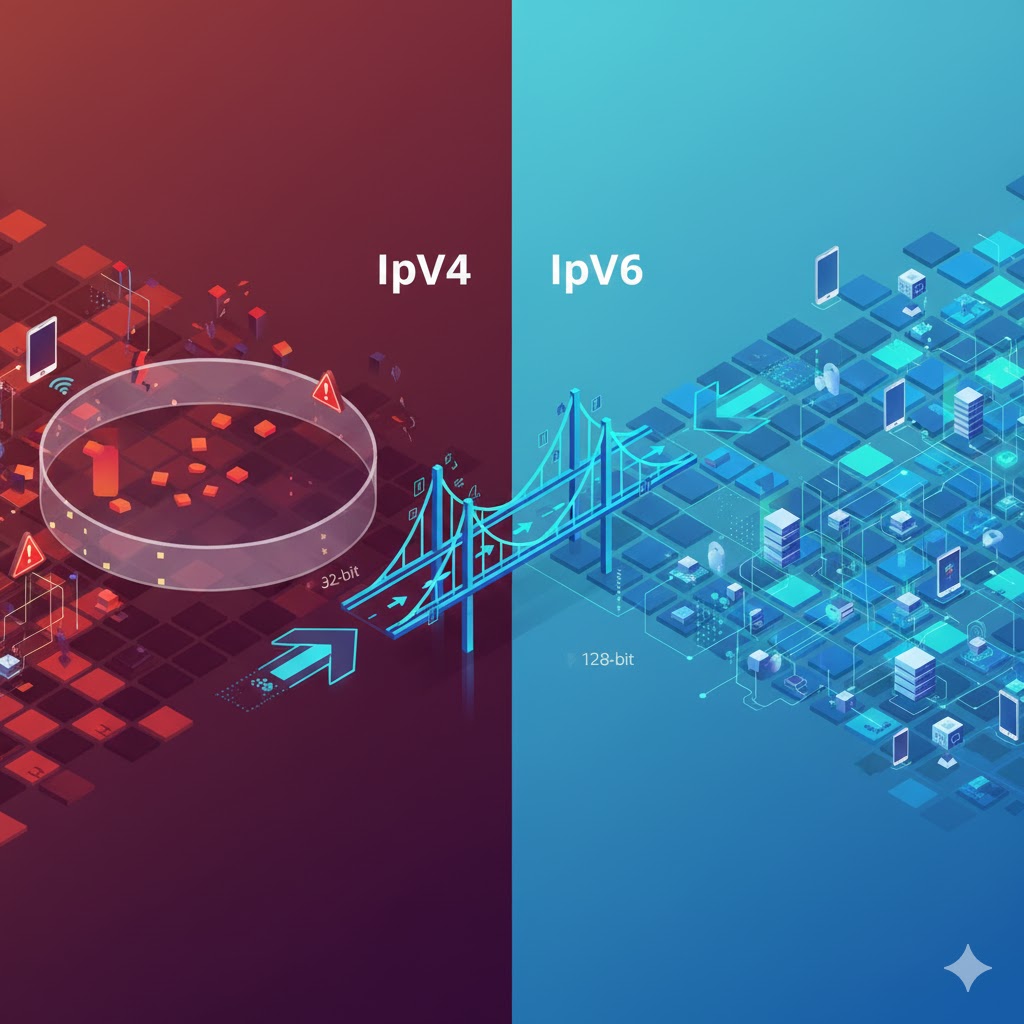
Visual comparison of IPv4 address exhaustion versus IPv6 unlimited address space
From my perspective working with diverse organizations at InterLIR, this Route 53 update addresses several critical business concerns that extend far beyond technical specifications. Let me break down the practical implications I see for different types of organizations.
One of the most immediate benefits is cost avoidance. Organizations planning significant infrastructure expansion face a choice: purchase expensive IPv4 address blocks on the secondary market or transition to IPv6. With Route 53 now supporting IPv6 at the API level, AWS has removed a significant barrier to IPv6 adoption for DNS management operations.
Consider a growing SaaS company that needs to expand its infrastructure to support international growth. In the IPv4-only world, they would need to acquire additional address blocks, potentially spending tens of thousands of dollars depending on the quantity needed. With IPv6 support throughout their stack-including DNS management via Route 53-they can deploy new infrastructure without these acquisition costs.
Many organizations, particularly those working with government agencies or operating in regulated industries, face IPv6 mandates. The U.S. government, for example, has required IPv6 capability for all networked IT systems since 2008, with increasingly strict enforcement. European Union institutions have similar requirements. Route 53’s IPv6 support helps organizations meet these compliance requirements without maintaining complex translation mechanisms.
Government Contractors – Can now manage DNS operations in compliance with federal IPv6 mandates
Healthcare Organizations – Meet evolving requirements for modern network infrastructure while maintaining HIPAA compliance
Financial Services – Align with regulatory expectations for current technology standards
Educational Institutions – Comply with research network requirements that increasingly mandate IPv6 support
In my conversations with network administrators and DevOps teams, I consistently hear about the operational burden of managing dual-protocol environments with translation mechanisms. Network Address Translation (NAT) and protocol translation gateways add complexity, create potential failure points, and complicate troubleshooting.
Route 53’s native IPv6 support eliminates these translation layers for DNS API interactions. This simplification has cascading benefits: cleaner automation scripts, more straightforward monitoring, and reduced troubleshooting complexity when issues arise. For organizations with lean IT teams-which describes most of the businesses we work with at InterLIR-this operational simplification translates directly to reduced management overhead.
Having helped numerous organizations plan their IP addressing strategies, I’ve developed strong opinions about effective implementation approaches. The key is treating IPv6 adoption as a strategic initiative rather than a purely technical project.
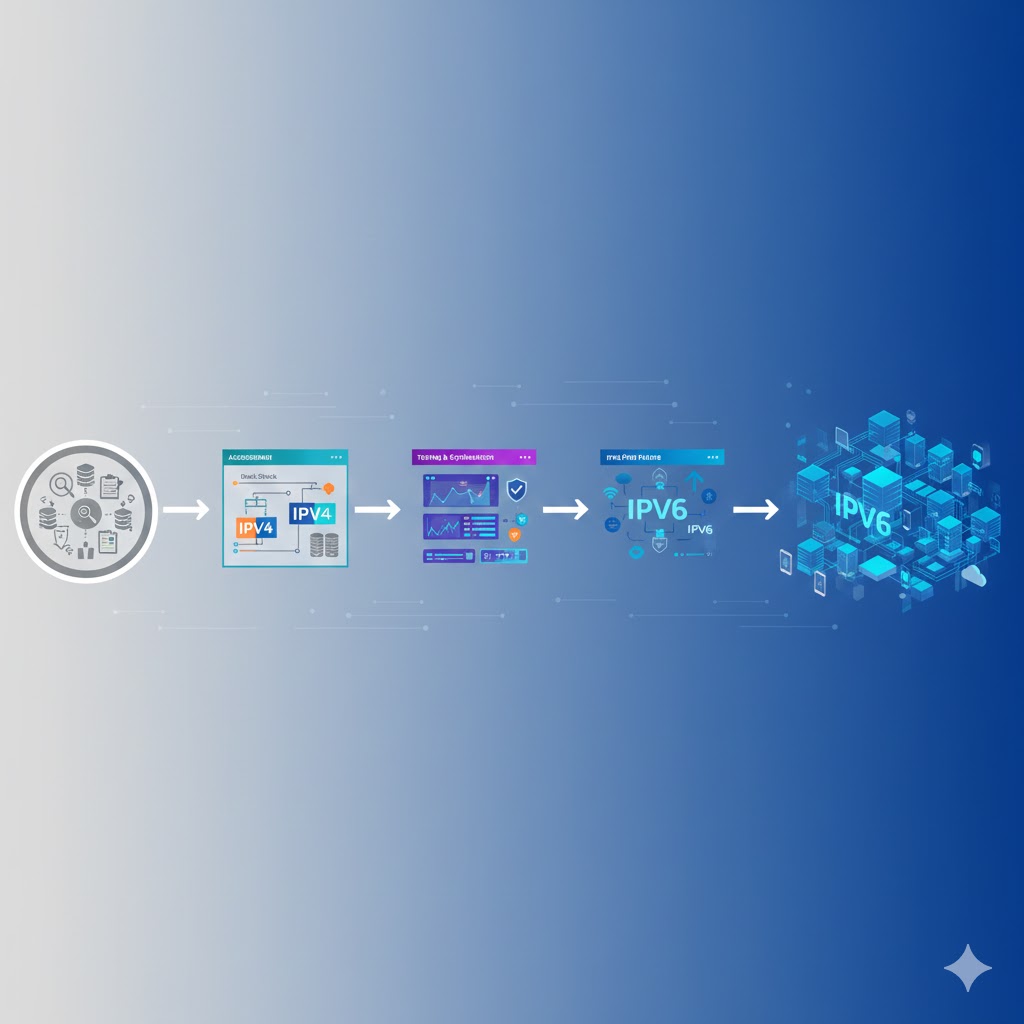
IPv6 migration roadmap showing phased transition strategy from dual-stack to IPv6-first infrastructure
Organizations should approach Route 53 IPv6 adoption systematically, aligning with broader network modernization efforts. Based on patterns I’ve observed in successful transitions, I recommend this framework:
Infrastructure Assessment – Inventory all systems that interact with Route 53 APIs, documenting their IPv6 readiness. This includes automation tools, monitoring systems, and custom applications.
Pilot Testing – Create isolated test environments to validate IPv6 functionality for Route 53 interactions. Test both direct IPv6 connections and dual-stack configurations.
Dual-Stack Deployment – Enable both IPv4 and IPv6 for Route 53 API interactions, allowing systems to use whichever protocol is most appropriate for their configuration.
Monitoring and Optimization – Implement IPv6-aware monitoring to track performance, identify issues, and optimize configurations based on real-world usage patterns.
IPv6 Preference Configuration – Once stability is confirmed, configure systems to prefer IPv6 when both protocols are available, gradually shifting traffic to the modern protocol.
Through my work at InterLIR, I’ve seen organizations encounter predictable challenges during IPv6 transitions. Being aware of these potential issues helps teams plan more effectively:
Legacy Tool Compatibility – Some older network management tools lack proper IPv6 support. Organizations may need to update or replace these tools as part of their transition.
Firewall Rule Complexity – IPv6 addresses require different firewall rule structures. Security teams need training and time to develop appropriate rule sets.
Monitoring Gaps – Existing monitoring configurations may not properly track IPv6 metrics. Teams should audit and update monitoring before production deployment.
Documentation Updates – Network documentation, runbooks, and troubleshooting guides need updates to reflect dual-stack or IPv6-only configurations.
Route 53’s IPv6 support doesn’t exist in isolation-it’s part of a broader industry transformation that’s accelerating rapidly. At InterLIR, we track these trends closely because they directly impact the IPv4 address market and our customers’ strategic planning.
IPv6 adoption has reached a tipping point in many markets. Google reports that approximately 40% of its users now access services over IPv6, up from less than 10% just five years ago. Major mobile carriers have led this transition, with many deploying IPv6-only mobile networks that use translation mechanisms only when accessing IPv4-only services.
This adoption momentum creates a network effect: as more services support IPv6, the business case for IPv6-only deployments strengthens. AWS’s Route 53 update contributes to this momentum by ensuring that critical DNS infrastructure can operate natively in IPv6 environments.
As InterLIR’s Customer Account Manager, I’m often asked how IPv6 adoption affects IPv4 address values. The relationship is nuanced. While IPv6 adoption reduces long-term demand for IPv4 addresses, the transition period actually sustains IPv4 address values because organizations need both protocols during migration.
What we’re seeing is a shift in how organizations approach IPv4 acquisition. Rather than purchasing large blocks for long-term growth, businesses are increasingly acquiring smaller IPv4 allocations specifically for legacy system support and dual-stack transition periods. This changes the market dynamics but doesn’t eliminate IPv4’s value-at least not in the foreseeable future.
| Time Period | IPv4 Market Characteristic | IPv6 Adoption Level | Strategic Recommendation |
|---|---|---|---|
| 2020-2023 | Rising prices, strong demand | 15-25% global adoption | Acquire IPv4 for growth, plan IPv6 transition |
| 2024-2026 | Stable prices, selective demand | 25-40% global adoption | Dual-stack deployment, IPv6 preference |
| 2027-2030 | Declining demand, niche use cases | 40-60% global adoption | IPv6-first strategy, minimal IPv4 for legacy |
| 2031+ | Specialized market only | 60%+ global adoption | IPv6-only for new deployments |
One aspect of IPv6 that doesn’t receive enough attention in business discussions is its security implications. IPv6 was designed with security as a core consideration, incorporating features that were afterthoughts in IPv4’s original design.
IPv6 includes mandatory support for IPsec, providing authentication and encryption at the network layer. While IPsec can be implemented in IPv4 environments, it’s optional and often inconsistently deployed. In IPv6, this security foundation is standardized, potentially simplifying security architecture for organizations using Route 53’s IPv6 API endpoint.
Additionally, IPv6’s vast address space makes network scanning attacks significantly more difficult. In IPv4, attackers can feasibly scan entire subnets to identify active hosts. In IPv6, the address space is so large that random scanning becomes computationally impractical, providing a degree of security through obscurity.
However, IPv6 adoption also requires security teams to update their practices and tools. Organizations implementing Route 53’s IPv6 support should consider:
Firewall Rule Updates – Ensure firewall rules properly handle IPv6 traffic to and from Route 53 endpoints
Intrusion Detection Systems – Verify that IDS/IPS systems can properly analyze IPv6 traffic patterns
Logging and Monitoring – Update security logging to capture IPv6 addresses and traffic characteristics
Incident Response Procedures – Train security teams on IPv6-specific investigation techniques and tools
Looking ahead from my vantage point at InterLIR, where we help organizations navigate network infrastructure transitions daily, I see Route 53’s IPv6 support as an indicator of broader trends that will shape network architecture over the next decade.
We’re entering a period where new deployments will increasingly default to IPv6-first or IPv6-only architectures. Route 53’s update removes a significant barrier to this transition for AWS customers. As more services follow suit, the operational burden of maintaining dual-stack environments will decrease, accelerating the shift toward IPv6 predominance.
This transition will be gradual and uneven across different sectors and regions. Organizations with newer infrastructure and fewer legacy constraints will move faster, while those with extensive legacy systems will maintain dual-stack configurations longer. Understanding where your organization falls on this spectrum is crucial for effective planning.
For organizations developing long-term IP address strategies, Route 53’s IPv6 support reinforces several key principles I recommend to InterLIR customers:
Right-Size IPv4 Holdings – Acquire only the IPv4 addresses needed for legacy support and transition periods, not for long-term growth
Prioritize IPv6 for New Deployments – Default to IPv6 for new infrastructure, using IPv4 only where specifically required
Plan for Dual-Stack Transition – Budget for a multi-year transition period where both protocols coexist
Monitor Technology Evolution – Stay informed about IPv6 support in critical services and platforms to time transitions effectively
IPv6’s expanded address space and improved architecture align particularly well with emerging technology trends. The Internet of Things, edge computing, and 5G networks all benefit from IPv6’s capabilities. Route 53’s IPv6 support positions AWS customers to integrate these technologies more seamlessly into their infrastructure.
For example, IoT deployments can assign unique IPv6 addresses to individual devices without the complexity of NAT traversal. Edge computing nodes can communicate directly using IPv6, simplifying network architecture. These capabilities become more practical as core infrastructure services like Route 53 provide comprehensive IPv6 support.
Amazon Route 53’s IPv6 API endpoint support represents a significant milestone in cloud infrastructure evolution, with implications that extend far beyond technical specifications. From my perspective at InterLIR, where we help organizations navigate the complexities of IP resource management daily, this update addresses real business challenges around cost optimization, regulatory compliance, and operational simplification.
The dual-stack implementation provides a practical migration path that acknowledges the realities of enterprise IT environments. Organizations can transition to IPv6 gradually, maintaining backward compatibility while positioning themselves for a future where IPv6 predominates. This flexibility is crucial because network infrastructure transitions cannot happen overnight-they require careful planning, testing, and phased implementation.
For businesses planning their network strategies, Route 53’s IPv6 support should be viewed as part of a broader industry transformation. IPv6 adoption is accelerating globally, driven by IPv4 address scarcity, regulatory requirements, and the technical advantages of the newer protocol. Organizations that begin planning their IPv6 transitions now will be better positioned to manage costs, meet compliance requirements, and leverage emerging technologies that benefit from IPv6’s capabilities.
At InterLIR, we’ve built our business around helping organizations navigate the IPv4 address marketplace, but we also recognize that IPv6 represents the future of internet addressing. Route 53’s update is one more indicator that this future is arriving faster than many organizations anticipated. The question is no longer whether to adopt IPv6, but how to manage the transition strategically to minimize disruption while maximizing the benefits of modern network infrastructure.
Whether you’re managing DNS operations for a growing startup, overseeing infrastructure for a regulated enterprise, or planning network architecture for emerging technologies, Route 53’s IPv6 support provides a foundation for building more scalable, secure, and cost-effective systems. The organizations that approach this transition strategically-viewing it as an opportunity rather than merely a technical requirement-will be best positioned to thrive in the evolving internet landscape.

Vladislava Shadrina
Customer Account Manager

A Beginner’s Guide to Subnetting IPv4 and IPv6 Addresses Subnetting is a critical

Why IPv4 Leasing Is Becoming the Smart Choice for Businesses in 2025 1. Introduction
As CEO of InterLIR, I’ve witnessed firsthand how network isolation strategies

What is an ASN? ASN stands for Autonomous System Number. It is a unique identifier

Anycast DNS: A Leader’s Guide to Protecting Your Digital Infrastructure Executive

RPKI Certification: A Leader’s Guide to Internet Routing Security Executive

Executive Summary: What You Need to Know 🎯 Strategic Importance – Internet

When AWS DynamoDB failed in October 2025, thousands of businesses discovered that

Executive Summary: What You Need to Know 🎯 IP reputation directly impacts your
Live chat is provided by Intercom and is loaded only after you enable it. You can also contact us without enabling the chat.