As a Customer Service Specialist at InterLIR, I’ve witnessed firsthand how IPv4 address exhaustion impacts organizations worldwide. Every day, we help businesses navigate the complexities of IP address management, and one question increasingly dominates our conversations: how can companies transition to IPv6 while maintaining operational continuity? AWS Lambda’s recent introduction of dual-stack endpoints represents a significant milestone in this journey, offering a practical pathway for organizations to embrace IPv6 without abandoning their existing IPv4 infrastructure.
The serverless computing revolution has transformed how we build and deploy applications, but network connectivity has remained anchored to IPv4 protocols-until now. With AWS Lambda now supporting IPv6 through dual-stack endpoints, organizations have an opportunity to fundamentally reimagine their serverless networking architecture. This comprehensive guide examines the technical, operational, and financial implications of this transition, drawing on real-world implementation experiences and industry best practices.
The IPv4 address space, with its approximately 4.3 billion possible addresses, seemed limitless when first designed in the 1980s. Today, this limitation represents one of the most pressing infrastructure challenges facing the internet. At InterLIR, we’ve observed the IPv4 marketplace evolve dramatically as organizations compete for increasingly scarce address blocks, with prices reflecting this scarcity.
IPv6 fundamentally solves this problem through its 128-bit addressing scheme, providing approximately 340 undecillion unique addresses-a number so vast it’s difficult to comprehend. To put this in perspective, IPv6 offers enough addresses to assign billions of unique IPs to every person on Earth. This abundance eliminates the need for complex Network Address Translation (NAT) workarounds that have become standard practice in IPv4 networking.
For AWS Lambda users, the transition to IPv6 offers several compelling advantages beyond simple address availability:
🌐 Future-proof architecture – Positioning infrastructure for inevitable industry-wide IPv6 adoption while maintaining current operational capabilities
💰 Significant cost reduction – Eliminating NAT Gateway charges by leveraging free egress-only internet gateways, potentially saving thousands of dollars monthly for high-traffic applications
⚡ Enhanced performance – Reducing network latency by eliminating NAT translation overhead and decreasing the number of network hops
🔄 Simplified network topology – Enabling direct end-to-end connectivity without complex address translation mechanisms
🛡️ Improved security capabilities – Leveraging IPv6’s built-in IPsec support and eliminating certain attack vectors associated with NAT
🎯 Better Quality of Service – Utilizing IPv6’s enhanced QoS capabilities for prioritizing critical application traffic
From my experience supporting customers through infrastructure transitions, I’ve learned that understanding the “why” behind technical changes is just as important as understanding the “how.” The IPv6 transition isn’t merely a technical upgrade-it’s a strategic investment in long-term infrastructure sustainability.
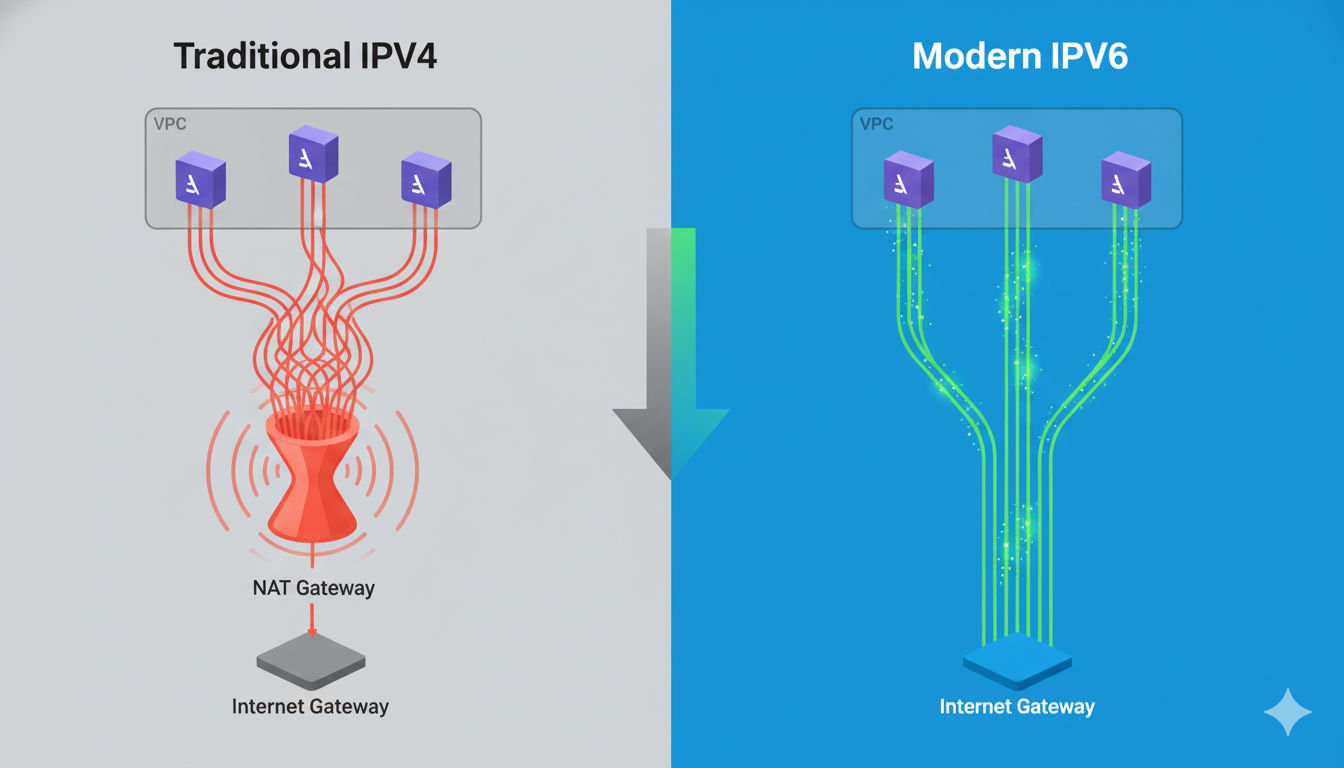
IPv6 network architecture diagram showing Lambda functions bypassing NAT gateways
The introduction of IPv6 support fundamentally alters the architectural patterns we use for Lambda functions, particularly those deployed within Virtual Private Clouds. Understanding these changes is essential for making informed decisions about when and how to implement IPv6 in your serverless environment.
Traditionally, Lambda functions requiring internet access from within a VPC have relied on NAT Gateways-a necessary but expensive component of IPv4 networking. These gateways translate private IPv4 addresses to public ones, enabling outbound internet connectivity while maintaining security. However, this architecture introduces several challenges:
| Architectural Component | IPv4 Implementation | IPv6 Implementation | Impact |
|---|---|---|---|
| Internet Gateway Type | NAT Gateway | Egress-Only Internet Gateway | Cost elimination |
| Monthly Gateway Cost | $32.40 base + data processing | $0.00 | Direct savings |
| Data Processing Charges | $0.045 per GB | $0.00 | Scales with traffic |
| Network Translation | Required (adds latency) | Not required | Performance improvement |
| Network Hops | Additional hop through NAT | Direct routing | Reduced latency |
| Scalability Limits | NAT Gateway capacity | No gateway bottleneck | Better scalability |
The financial implications become particularly significant at scale. Consider a Lambda function processing 1TB of outbound traffic monthly through a NAT Gateway. Under IPv4 architecture, this incurs approximately $77.40 in monthly charges ($32.40 base + $45.00 for data processing). With IPv6 using an egress-only internet gateway, these charges disappear entirely. For organizations running multiple high-traffic Lambda functions, annual savings can easily reach tens of thousands of dollars.
AWS Lambda’s implementation of IPv6 support uses a dual-stack approach, meaning functions can communicate using both IPv4 and IPv6 protocols simultaneously. This design choice is crucial for maintaining compatibility during the transition period. When a Lambda function with dual-stack enabled needs to communicate with an external service, it will:
This intelligent protocol selection ensures maximum compatibility while enabling organizations to benefit from IPv6 advantages wherever possible. In my work at InterLIR, I’ve seen how this approach reduces the risk associated with infrastructure transitions-a critical consideration for production environments.
One often-overlooked aspect of Lambda’s IPv6 implementation is that Function URLs are inherently dual-stack capable without any configuration changes. This means that if you’re using Lambda Function URLs to expose your functions as HTTP endpoints, IPv6 clients can already access them regardless of your VPC configuration.
This built-in capability operates independently of VPC settings because Function URLs are managed by AWS’s edge infrastructure, which already supports dual-stack networking. For many use cases, this means IPv6 support is already available without any migration effort-a pleasant surprise for organizations concerned about transition complexity.
Implementing IPv6 support for Lambda functions requires careful planning and systematic execution. Based on successful customer implementations I’ve supported, here’s a comprehensive approach that minimizes risk while maximizing benefits.
The foundation of IPv6 support begins with your VPC configuration. This phase involves several critical steps that must be completed before enabling IPv6 on Lambda functions:
Assign IPv6 CIDR Block to VPC – Navigate to your VPC configuration in the AWS Console and add an IPv6 CIDR block. AWS offers three options: Amazon-provided IPv6 CIDR blocks (/56 prefix), blocks allocated through Amazon VPC IP Address Manager (IPAM), or bring-your-own-IPv6 addresses (BYOIP). For most organizations, the Amazon-provided option offers the simplest implementation path.
Configure Subnet IPv6 CIDR Blocks – Unlike IPv4 subnets which may already exist, IPv6 CIDR blocks must be manually assigned to each subnet. AWS automatically divides your VPC’s /56 IPv6 block into /64 subnet blocks. Each subnet receives a unique /64 block, providing 18 quintillion addresses per subnet-more than sufficient for any conceivable Lambda deployment.
Create Egress-Only Internet Gateway – This component replaces the NAT Gateway for IPv6 traffic. Unlike NAT Gateways, egress-only internet gateways are free and don’t process data charges. They provide stateful egress-only access, meaning Lambda functions can initiate outbound connections, but unsolicited inbound connections are blocked-maintaining security while eliminating costs.
Update Route Tables – Add a route for ::/0 (all IPv6 addresses) pointing to your egress-only internet gateway. This route directs all IPv6 internet-bound traffic through the free gateway rather than the paid NAT Gateway. Your route table should now contain routes for both IPv4 (0.0.0.0/0 to NAT Gateway) and IPv6 (::/0 to Egress-Only Internet Gateway).
Security groups require careful attention during IPv6 implementation. By default, security groups allow all outbound traffic for both IPv4 and IPv6. However, many organizations implement more restrictive policies:
🔒 Review existing security group rules – Audit current IPv4 rules and determine which should be replicated for IPv6
🎯 Add specific IPv6 egress rules – If you’ve removed the default allow-all egress rule, add explicit rules for IPv6 traffic (using ::/0 notation)
🛡️ Configure ingress rules for PrivateLink – If using AWS PrivateLink for service access, ensure security groups permit IPv6 traffic from VPC endpoints
📋 Document IPv6 security policies – Update security documentation to reflect dual-stack configurations and any protocol-specific rules
With infrastructure prepared, you can now enable IPv6 on Lambda functions. This step requires careful orchestration to avoid service disruptions:
Create New Function Version – Rather than modifying your production function directly, publish a new version with IPv6 dual-stack enabled. This approach provides a clean rollback path if issues arise.
Enable IPv6 Dual-Stack – In the Lambda function configuration, navigate to VPC settings and enable IPv6. AWS will create new Elastic Network Interfaces (ENIs) that support both protocols. This process typically takes 1-2 minutes per function.
Implement Blue/Green Deployment – Use Lambda aliases to gradually shift traffic from the IPv4-only version to the dual-stack version. Start with a small percentage (10-20%) and monitor for issues before completing the transition.
Monitor and Validate – Watch CloudWatch metrics for any anomalies in invocation duration, error rates, or network connectivity. Pay particular attention to functions that communicate with external services.
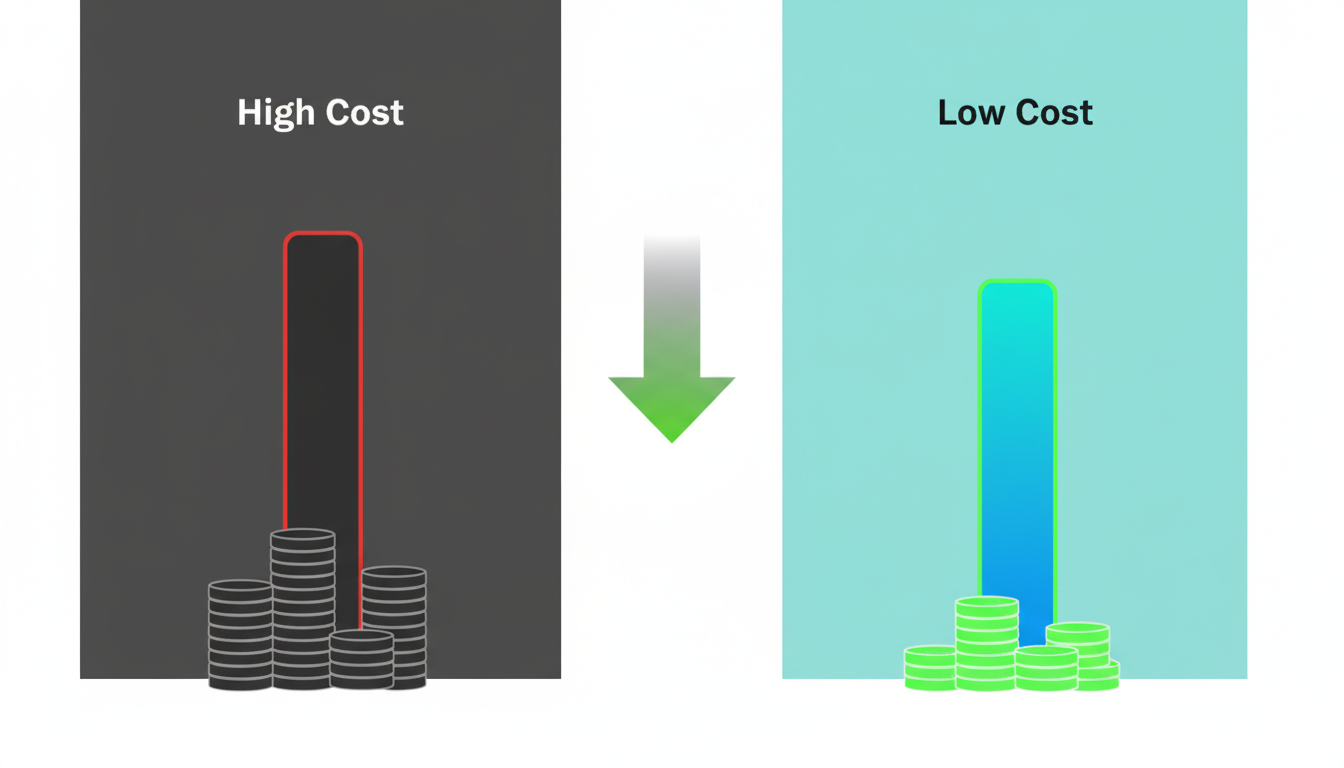
Cost comparison chart showing NAT Gateway versus IPv6 deployment expenses
Understanding the financial impact of IPv6 transition helps justify the implementation effort. Let me break down the cost implications based on real-world scenarios I’ve analyzed with InterLIR customers:
NAT Gateway charges consist of two components: hourly charges and data processing fees. For a single NAT Gateway in one availability zone:
| Cost Component | Monthly Charge | Annual Charge |
|---|---|---|
| Base hourly rate ($0.045/hour) | $32.40 | $388.80 |
| Data processing (100GB @ $0.045/GB) | $4.50 | $54.00 |
| Data processing (1TB @ $0.045/GB) | $45.00 | $540.00 |
| Data processing (10TB @ $0.045/GB) | $450.00 | $5,400.00 |
For high-availability architectures requiring NAT Gateways in multiple availability zones, these costs multiply accordingly. An organization running NAT Gateways in three availability zones with moderate traffic (1TB/month per gateway) would spend approximately $2,800 annually just on NAT Gateway infrastructure-costs that disappear entirely with IPv6 implementation.
Beyond direct cost savings, IPv6 offers performance improvements that translate to business value:
⚡ Reduced latency – Eliminating NAT translation typically reduces latency by 2-5 milliseconds per request. For high-frequency trading or real-time applications, this improvement can be significant.
📈 Increased throughput – Removing the NAT Gateway bottleneck enables Lambda functions to achieve higher network throughput, particularly important for data-intensive operations.
🔄 Better scalability – NAT Gateways have throughput limits (45 Gbps per gateway). IPv6’s direct routing eliminates this constraint, enabling better horizontal scaling.
Not all Lambda functions benefit equally from IPv6 implementation. Understanding which use cases gain the most value helps prioritize migration efforts:
🌐 Internet-facing APIs – Lambda functions serving HTTP requests to external clients benefit from both cost savings and improved performance. Functions handling high request volumes see the greatest impact.
🔄 External service integration – Functions that regularly communicate with third-party APIs or services gain compatibility with IPv6-only services while reducing NAT Gateway costs.
📊 Data processing pipelines – Lambda functions that download or upload large data volumes from internet sources see substantial cost reductions from eliminated data processing charges.
🎮 Real-time applications – Gaming backends, chat services, or live streaming functions benefit from reduced latency and improved network efficiency.
🔗 Internal AWS service communication – Functions that exclusively interact with other AWS services through service endpoints see minimal immediate benefits, though they gain future compatibility.
🗄️ Database access functions – Lambda functions primarily accessing RDS, DynamoDB, or other AWS databases within the VPC don’t benefit significantly from IPv6 unless they also make external calls.
⏱️ Infrequent invocations – Functions that run rarely (less than daily) won’t generate meaningful cost savings, though they still benefit from future-proofing.
Through supporting numerous IPv6 implementations at InterLIR, I’ve encountered several recurring challenges. Here’s how to address them effectively:
Some external services may not properly advertise their IPv6 capabilities through AAAA records, causing connection failures when Lambda prefers IPv6. Solutions include:
🔍 Verify DNS records – Use dig or nslookup to confirm target services have proper AAAA records
🔄 Implement retry logic – Add application-level retry mechanisms that can fall back to IPv4 if IPv6 connections fail
📝 Contact service providers – Work with third-party service providers to ensure proper IPv6 DNS configuration
Incorrectly configured security groups are the most common cause of connectivity issues after enabling IPv6:
| Symptom | Likely Cause | Solution |
|---|---|---|
| Outbound connections fail | Missing IPv6 egress rules | Add ::/0 egress rule to security group |
| PrivateLink access fails | Missing IPv6 ingress from VPC endpoint | Add ingress rule for VPC endpoint IPv6 range |
| Intermittent connectivity | Mixed IPv4/IPv6 security rules | Ensure consistent rules for both protocols |
When enabling IPv6 on Lambda functions, AWS creates new Elastic Network Interfaces. This process can take several minutes and may cause temporary connectivity issues. Mitigation strategies include:
🔵 Use blue/green deployments – Keep the old version running until new ENIs are fully operational
⏰ Schedule during maintenance windows – Perform IPv6 enablement during low-traffic periods
📊 Monitor ENI status – Watch CloudWatch metrics to confirm when new ENIs are ready
As the internet continues its inevitable transition to IPv6, organizations that proactively adopt dual-stack networking position themselves for long-term success. Based on industry trends and AWS’s strategic direction, I recommend these forward-looking practices:
🎯 Make dual-stack the default – Configure Infrastructure as Code templates to enable IPv6 by default for new Lambda functions
📈 Track protocol usage metrics – Monitor the ratio of IPv4 to IPv6 traffic to understand adoption trends and identify optimization opportunities
🧪 Test IPv6-only scenarios – Periodically test Lambda functions in IPv6-only environments to prepare for future AWS regions or services that may not support IPv4
📚 Educate development teams – Ensure developers understand IPv6 addressing, troubleshooting, and best practices
🔄 Plan for IPv4 deprecation – While not imminent, prepare for a future where IPv4 support may become optional or deprecated
At InterLIR, we’ve observed that organizations taking a proactive approach to IPv6 adoption experience smoother transitions and better long-term outcomes than those forced to react to immediate pressures. The serverless computing model, with its abstraction of infrastructure management, provides an ideal opportunity to embrace IPv6 with minimal disruption.
The introduction of IPv6 support in AWS Lambda represents more than a technical enhancement-it’s a strategic opportunity to modernize serverless architectures while achieving tangible operational benefits. Through my work at InterLIR helping organizations navigate IP address management challenges, I’ve seen how IPv4 scarcity increasingly constrains infrastructure planning. Lambda’s dual-stack implementation offers a practical solution that addresses both immediate cost concerns and long-term compatibility requirements.
The financial benefits alone justify serious consideration of IPv6 adoption. Eliminating NAT Gateway charges can save thousands to tens of thousands of dollars annually, depending on your traffic patterns and architecture complexity. These savings compound when you factor in reduced network latency, simplified infrastructure management, and improved scalability characteristics.
However, the true value of IPv6 adoption extends beyond immediate cost savings. By implementing dual-stack networking today, you’re positioning your serverless infrastructure for a future where IPv6 becomes the primary-and eventually, perhaps the only-internet protocol. The transition period we’re currently experiencing offers a unique window where organizations can adopt IPv6 at their own pace while maintaining full IPv4 compatibility.
For organizations beginning this journey, I recommend starting with high-traffic, internet-facing Lambda functions where cost savings and performance improvements will be most noticeable. Use the implementation roadmap provided in this guide to systematically enable IPv6 across your serverless infrastructure, learning from each deployment and refining your approach. The blue/green deployment strategy minimizes risk while providing valuable operational experience with dual-stack networking.
As AWS continues expanding IPv6 support across its service portfolio, early adopters will find themselves better positioned to leverage new capabilities and optimizations. The serverless paradigm’s promise of reduced operational overhead becomes even more compelling when combined with IPv6’s simplified networking model. Together, they represent the future of cloud infrastructure-one where developers focus on business logic while the platform handles the complexities of modern internet protocols.
Whether you’re motivated by cost optimization, performance improvement, or future-proofing your architecture, AWS Lambda’s IPv6 support provides a clear path forward. The implementation may require careful planning and systematic execution, but the long-term benefits-both financial and operational-make this transition a worthwhile investment in your serverless infrastructure’s future.

Nikita Sinitsyn
Customer Service Specialist

A Beginner’s Guide to Subnetting IPv4 and IPv6 Addresses Subnetting is a critical

Why IPv4 Leasing Is Becoming the Smart Choice for Businesses in 2025 1. Introduction
As CEO of InterLIR, I’ve witnessed firsthand how network isolation strategies

What is an ASN? ASN stands for Autonomous System Number. It is a unique identifier

Anycast DNS: A Leader’s Guide to Protecting Your Digital Infrastructure Executive

RPKI Certification: A Leader’s Guide to Internet Routing Security Executive

Executive Summary: What You Need to Know 🎯 Strategic Importance – Internet

When AWS DynamoDB failed in October 2025, thousands of businesses discovered that

Executive Summary: What You Need to Know 🎯 IP reputation directly impacts your
Live chat is provided by Intercom and is loaded only after you enable it. You can also contact us without enabling the chat.