Bring Your Own IP, or BYOIP, allows a company to use its own public IP address range with a cloud, CDN, hosting, DDoS protection, or network provider instead of relying only on provider-assigned IPs. For businesses that depend on stable IP reputation, firewall allowlists, predictable routing, or multi-cloud flexibility, BYOIP can be an important part of infrastructure planning.
The BYOIP process is also becoming more technical. Traditional onboarding often relied on manual review, Letters of Authorization, and long communication between account teams, engineers, and network operators. Modern BYOIP workflows increasingly use RPKI/ROA, IRR route objects, RDAP or WHOIS data, reverse DNS, TXT records, and provider-specific verification tokens to confirm that a customer is authorized to use and route a prefix.
This is especially relevant for companies that lease IPv4 addresses. A leased IPv4 range can sometimes be prepared for BYOIP, but only when the authorization chain, routing records, registry data, provider policy, and technical setup all support the intended use case. InterLIR’s Bring Your Own IP service helps businesses lease IPv4 ranges and prepare the IP-side configuration required for BYOIP, including route objects, RPKI/ROA support, LOA documentation, WHOIS management, and verification tokens where applicable.
BYOIP stands for Bring Your Own IP. It means that an organization brings an IP prefix it owns or is authorized to use into a third-party provider’s infrastructure.
Instead of changing to IP addresses assigned by a cloud or hosting provider, the company keeps using a familiar public IP range while moving workloads, applications, traffic delivery, or security services to a new environment.
In practice, BYOIP helps organizations preserve control over their public IP identity. This can be useful during cloud migration, CDN onboarding, hybrid infrastructure deployment, disaster recovery planning, DDoS protection setup, or multi-cloud architecture design.
Companies usually consider BYOIP when public IP addresses are not just technical resources, but part of their operational identity. A stable IP range may already be trusted by customers, partners, firewalls, payment systems, SaaS platforms, security tools, or email infrastructure.
For many organizations, the main value of BYOIP is continuity. They can modernize infrastructure without changing the public IP addresses that customers, systems, and partners already recognize.
Historically, BYOIP onboarding was often slow and document-heavy. A customer would submit a request, provide a Letter of Authorization, wait for manual review, and coordinate with provider teams before the prefix could be accepted and announced.
This process made sense from a security perspective, because providers need to avoid unauthorized route announcements. However, it was not always efficient. Technical teams could be ready to deploy infrastructure while still waiting for administrative approval.
Self-serve BYOIP changes this model. Instead of relying only on PDFs and manual checks, providers can validate IP prefix control and routing intent through technical records, cryptographic routing data, APIs, and automated checks. In many cases, documents are still used, but they are increasingly complemented by verifiable routing and registry signals.
| Area | Traditional BYOIP | Self-Serve or Automated BYOIP |
|---|---|---|
| Verification | Manual document review, LOA checks, account-team communication, and engineering approval | Technical validation through RPKI/ROA, IRR, RDAP/WHOIS, rDNS, TXT records, or provider tokens |
| Speed | Often days or weeks, depending on provider requirements and documentation | Potentially faster when all routing and authorization records are prepared correctly |
| Security model | Depends heavily on document review and human approval | Uses cryptographic and registry-based validation where supported |
| Customer control | Provider-led process through support tickets or account teams | More direct control through APIs, portals, and technical records |
| Remaining limitations | Can be slow and difficult to automate | Still depends on provider policy, prefix size, registry data, ROA accuracy, and authorization chain |
A modern BYOIP workflow may use RPKI/ROA to confirm which ASN is authorized to originate a prefix, IRR route objects to support routing policy and filtering, RDAP or WHOIS data to confirm registry-level information, reverse DNS or TXT records for ownership validation, provider-specific verification tokens, and LOA documentation where documents are still required.
This does not remove the need for authorization. It makes the authorization process more technical, more verifiable, and often easier to audit.

Manual BYOIP verification is increasingly complemented by automated validation through RPKI, IRR, rDNS, RDAP, and provider-side checks.
A secure BYOIP process normally needs to answer two questions. First, does the customer have legitimate control over the IP prefix or authorization to use it? Second, is the provider allowed to announce or use that prefix in the intended network?
RPKI, or Resource Public Key Infrastructure, is used to improve routing security. A ROA, or Route Origin Authorization, is a cryptographically signed object that states which Autonomous System is authorized to originate a certain IP prefix.
In a BYOIP setup, the customer or resource holder may need to create or update a ROA so the provider’s ASN is authorized to originate the prefix. If the ROA is missing, wrong, expired, or too restrictive, the route may be rejected by networks that perform Route Origin Validation.
This is one of the most important technical checks in modern BYOIP. A small ROA mistake can cause serious routing problems, especially if the prefix is already being validated by upstream networks.
IRR route objects are still widely used by network operators to build filters and validate routing policy. Even when RPKI is in place, route objects may still be required by upstreams, peers, cloud providers, CDN networks, or DDoS protection providers.
For BYOIP, route objects help show that a prefix is intended to be routed through a specific ASN or network path. Keeping them accurate reduces the risk of routing filters blocking the prefix.
RDAP and WHOIS records help providers review registry-level information about an IP range. Depending on the provider and registry, these records may be used to confirm organization details, contact information, remarks, comments, or authorization chains.
Some providers may also require a verification token, certificate, or other validation record to be placed in RDAP, WHOIS, reverse DNS, TXT records, or another controlled location. This helps connect the IP range to a specific BYOIP request or provider account.
Reverse DNS can be used as a practical proof of operational control when the customer or IP resource holder can publish a required token. TXT-based verification is also common in automated workflows because it gives the provider a simple way to check that the party requesting BYOIP can modify a delegated record.
Even with RPKI and automated validation, Letters of Authorization are still used in some BYOIP workflows. Many network operators continue to rely on documents as part of their routing acceptance process.
For leased IPv4 ranges, LOA documentation can be especially important. It helps show that the customer has permission to use the range for the requested BYOIP purpose and that there is a clear authorization chain from the resource holder to the end user.
| Validation Element | What It Proves | Why It Matters |
|---|---|---|
| RPKI/ROA | Which ASN is authorized to originate the prefix | Helps prevent route hijacks and routing validation failures |
| IRR route object | Declared routing policy for the prefix | Still used by many networks for route filtering |
| RDAP/WHOIS data | Registry-level information about the resource | Helps providers confirm the authorization chain |
| rDNS or TXT token | Operational control over a delegated record | Can support automated provider-side verification |
| LOA documentation | Written authorization to announce or use the range | Still required by some providers, peers, or legacy workflows |
Not every company that needs BYOIP already owns IPv4 space. Buying IPv4 addresses can require significant capital investment, while provider-assigned cloud IPs may become expensive, limited, or unsuitable for workloads that depend on reputation and long-term continuity.
Leasing IPv4 addresses can be a practical alternative, but BYOIP with leased IPv4 must be handled carefully. A leased range is suitable only when the lease terms, authorization documents, registry data, routing policy, and target provider requirements all allow the intended BYOIP use.
The most important point is that the leased range must support the technical and administrative requirements of the target platform. This may include RPKI/ROA, route objects, LOA documentation, WHOIS or RDAP updates, reverse DNS, verification tokens, and a clear abuse-handling process.
InterLIR’s BYOIP service is designed for this scenario. InterLIR helps with the IP-side preparation of leased IPv4 ranges, while the client completes provider-side onboarding inside AWS, Azure, Google Cloud, Cloudflare, or another provider’s own portal, account, and tools.
BYOIP is used differently across cloud, CDN, hosting, DDoS protection, and network providers. The general idea is similar: the customer brings an IP prefix, proves authorization, and the provider makes the range usable in its infrastructure.
However, the exact requirements vary. One provider may require a specific minimum prefix size. Another may require a particular ROA, LOA format, verification token, regional onboarding process, account permission, or provisioning timeline.
| Provider Type | Typical BYOIP Purpose | Important Planning Point |
|---|---|---|
| Public cloud | Use your own IP ranges for cloud resources, migration, allowlists, and reputation continuity | Check prefix size, region, validation method, provisioning timeline, and account-level permissions |
| CDN and edge networks | Keep customer-owned or authorized IP identity while using edge delivery or security services | Confirm how the provider validates prefix control and binds traffic to the correct service |
| DDoS protection providers | Route traffic through a protection network while keeping existing public IP ranges | ROA, route objects, BGP cutover timing, and rollback planning must be handled carefully |
| Hosting and bare metal providers | Use external IPv4 ranges with servers or network infrastructure | Confirm BGP, LOA, IRR, RPKI, rDNS, and abuse contact requirements before deployment |
Because of these differences, businesses should always check the target provider’s current BYOIP requirements before leasing, preparing, or migrating a range.
Before starting a BYOIP project, prepare the technical and administrative elements that providers commonly request. Exact requirements vary between platforms, but the following checklist covers the most common areas.
Most BYOIP problems happen because one of these elements is missing, outdated, or configured incorrectly. Preparing them in advance can make onboarding smoother and reduce the risk of routing failures.
BYOIP gives companies more control, but it also creates more responsibility. Incorrect routing data or poor migration planning can lead to failed validation, traffic loss, rejected routes, or reputation problems.
A safe BYOIP deployment should include routing checks, staged migration, reachability testing, service binding validation, and monitoring after cutover.
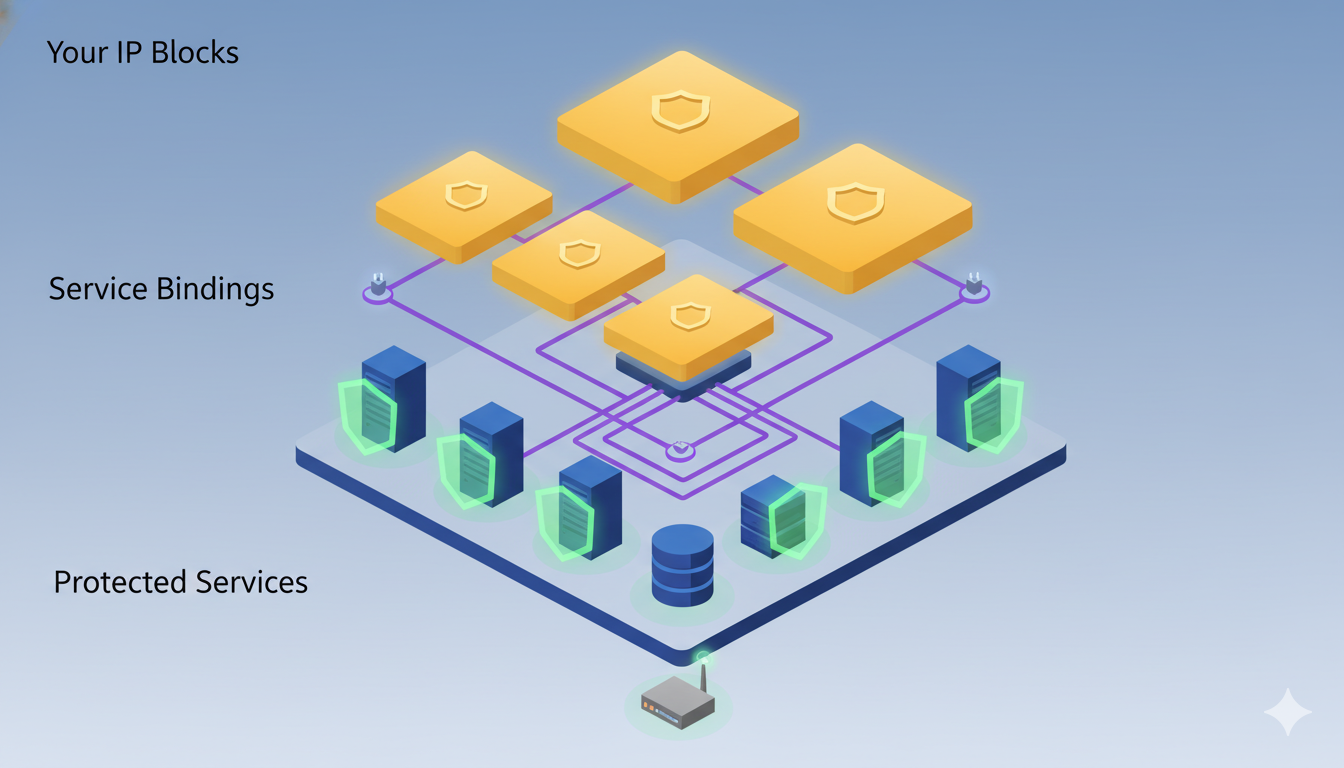
BYOIP routing should be planned together with service configuration to avoid traffic loss during advertisement or migration.
One of the main benefits of BYOIP is reputation continuity. If a company already uses an IP range with a clean history and trusted reputation, BYOIP can help preserve that value when infrastructure changes.
However, reputation can also become a risk. If a leased range has previous abuse history, blocklist issues, poor geolocation data, or unclear routing history, those problems may follow the range into the new environment.
Before using any IPv4 range for BYOIP, businesses should check its reputation, abuse history, blocklist status, geolocation expectations, routing history, and suitability for the intended workload.
InterLIR helps organizations lease IPv4 ranges and prepare them for BYOIP use cases. Depending on the range, provider, registry, and project requirements, InterLIR can support the IP-side setup needed for onboarding.
The cloud-side setup remains the client’s responsibility and is completed inside the provider’s own account, portal, API, and tools. InterLIR supports the IP-side configuration needed to make that onboarding possible.
For companies that want to use leased IPv4 addresses in cloud, CDN, hosting, or network environments, this can reduce friction and help avoid common routing and verification mistakes.
BYOIP means Bring Your Own IP. It allows a company to use its own or authorized public IP address range inside a third-party cloud, CDN, hosting, DDoS protection, or network provider’s infrastructure.
Yes, leased IPv4 addresses can sometimes be used for BYOIP when the lease arrangement supports the required authorization, routing, registry, and provider verification steps. The range must be checked against the target provider’s current requirements before deployment.
Not always in every workflow, but RPKI/ROA is increasingly important. Many providers and networks use ROA data to validate routing authorization, and an incorrect ROA can cause route validation failures.
A ROA, or Route Origin Authorization, is a cryptographically signed object that states which ASN is authorized to originate a specific IP prefix.
With provider-assigned IPs, the cloud or hosting provider gives the customer addresses from the provider’s own pool. With BYOIP, the customer brings an IP range it owns or is authorized to use, and the provider makes that range usable inside its infrastructure.
BYOIP can help preserve IP reputation because the organization continues using the same public IP range. However, reputation should always be checked before onboarding, especially with leased IPv4 addresses.
No. InterLIR supports the IP-side configuration, including route objects, RPKI/ROA support, LOA documentation, WHOIS management, and verification tokens where applicable. The client completes provider-side setup inside the cloud, CDN, hosting, or network provider account.
BYOIP is becoming an important part of modern IP management. It helps businesses keep control over their public IP identity while using cloud, CDN, hosting, DDoS protection, or network-provider infrastructure.
Self-serve and automated BYOIP workflows make the process more technical, but they also make preparation more important. RPKI/ROA, IRR route objects, RDAP or WHOIS data, LOA documentation, verification tokens, and migration planning all need to be handled carefully.
For organizations that do not own IPv4 space, leased IPv4 ranges can provide a practical path to BYOIP when the IP-side authorization and routing setup are properly prepared. InterLIR helps businesses lease BYOIP-ready IPv4 ranges and prepare the IP-side configuration needed for cloud and network provider onboarding.
InterLIR helps businesses lease IPv4 ranges and prepare the IP-side configuration required for BYOIP, including route objects, RPKI/ROA support, LOA documentation, WHOIS management, and verification tokens where applicable.
Explore InterLIR BYOIP Solutions
Nikita Sinitsyn
Customer Service Specialist

A Beginner’s Guide to Subnetting IPv4 and IPv6 Addresses Subnetting is a critical

Why IPv4 Leasing Is Becoming the Smart Choice for Businesses in 2025 1. Introduction
As CEO of InterLIR, I’ve witnessed firsthand how network isolation strategies

What is an ASN? ASN stands for Autonomous System Number. It is a unique identifier

Anycast DNS: A Leader’s Guide to Protecting Your Digital Infrastructure Executive

RPKI Certification: A Leader’s Guide to Internet Routing Security Executive

Executive Summary: What You Need to Know 🎯 Strategic Importance – Internet

When AWS DynamoDB failed in October 2025, thousands of businesses discovered that

Executive Summary: What You Need to Know 🎯 IP reputation directly impacts your
Live chat is provided by Intercom and is loaded only after you enable it. You can also contact us without enabling the chat.