bgunderlay bgunderlay bgunderlay

IPv4 Header Format Explained

The IPv4 header serves as the starting point of every IPv4 packet and plays a vital role in routing the packet to its intended destination. This fixed-size data structure contains essential information used by networking hardware. The fields within the IPv4 header are listed below in sequential order:
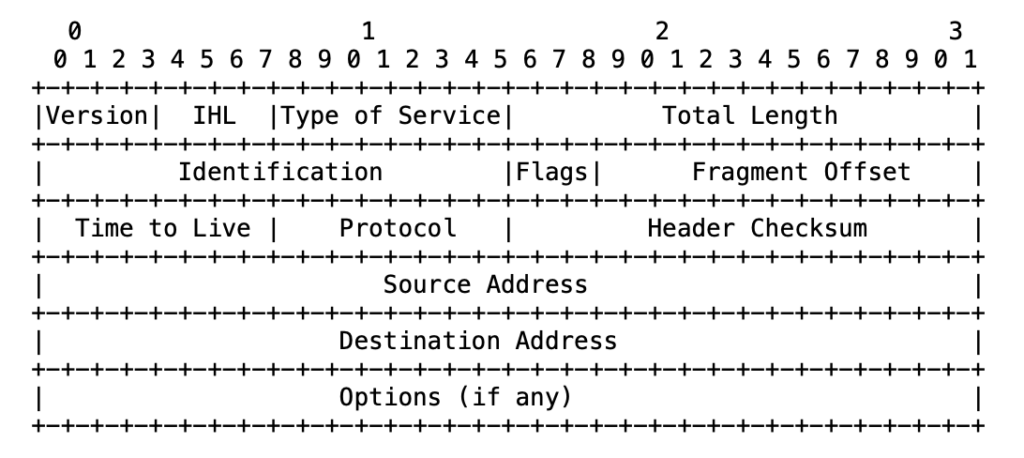
IPv4 Header Format Overview:

  1. Version (4 bits) – Indicates the version of the IP protocol being used. Always set to 4 for IPv4 packets.
  2. Header Length (4 bits) – Indicates the length of the header in 32-bit words, ranging from 5 to 15 due to optional fields.
  3. Type of Service (8 bits) – Describes handling needs and packet priority.
  4. Total Length (16 bits) – Indicates the overall packet length in bytes, including header and data.
  5. Identification (16 bits) – Used for fragmentation and reassembly, assigns a unique identification number to the packet.
  6. Flags (3 bits) – Regulates fragmentation with “More Fragments” (MF) and “Don’t Fragment” (DF) flags.
  7. Fragment Offset (13 bits) – Indicates the offset of data in the packet relative to the original unfragmented packet.
  8. Time to Live (8 bits) – Specifies the maximum number of hops a packet can make before being discarded.
  9. Protocol (8 bits) – Identifies the protocol used in the data section, e.g., TCP, UDP, or ICMP.
  10. Header Checksum (16 bits) – Used to check the header’s integrity.
  11. Source Address (32 bits) – Contains the IP address of the sender.
  12. Destination Address (32 bits) – Contains the IP address of the recipient.
  13. Options (variable) – Optional field for additional information, like security and routing data.

This summarizes the key elements of the IPv4 header format.

Alexey Shkittin

CEO

    Ready to get started?

    Articles
    A Beginner’s Guide to Subnetting IPv4 and IPv6 Addresses (2026 Update)
    A Beginner’s Guide to Subnetting IPv4 and IPv6 Addresses (2026 Update)

    A Beginner’s Guide to Subnetting IPv4 and IPv6 Addresses Subnetting is a critical

    More
    IPv4 Leasing Revolution: Why Smart Businesses Are Ditching Ownership in 2025
    IPv4 Leasing Revolution: Why Smart Businesses Are Ditching Ownership in 2025

    Why IPv4 Leasing Is Becoming the Smart Choice for Businesses in 2025 1. Introduction
    More
    Network Isolation Revolution: IPv4 Marketplace Insights for Enterprise Security
    Network Isolation Revolution: IPv4 Marketplace Insights for Enterprise Security

      As CEO of InterLIR, I’ve witnessed firsthand how network isolation strategies

    More
    What is ASN?
    What is ASN?

    What is an ASN? ASN stands for Autonomous System Number. It is a unique identifier

    More
    How Anycast DNS Actually Works (And Why Your Network Needs It)
    How Anycast DNS Actually Works (And Why Your Network Needs It)

    Anycast DNS: A Leader’s Guide to Protecting Your Digital Infrastructure Executive

    More
    Why RPKI Matters: Securing Your Company’s Internet Traffic
    Why RPKI Matters: Securing Your Company’s Internet Traffic

    RPKI Certification: A Leader’s Guide to Internet Routing Security Executive

    More
    Why RIPE Address Policy Matters for Your Company’s Digital Future
    Why RIPE Address Policy Matters for Your Company’s Digital Future

    Executive Summary: What You Need to Know 🎯 Strategic Importance – Internet

    More
    AWS Outages: The CEO’s Guide to Preventing Downtime & Protecting Revenue
    AWS Outages: The CEO’s Guide to Preventing Downtime & Protecting Revenue

      When AWS DynamoDB failed in October 2025, thousands of businesses discovered that

    More
    What I Wish CEOs Knew About Managing IP Reputation Risk
    What I Wish CEOs Knew About Managing IP Reputation Risk

    Executive Summary: What You Need to Know 🎯 IP reputation directly impacts your

    More
    How to Create a Subnet and Configure Routing
    How to Create a Subnet and Configure Routing

    Mastering Subnetting and Routing for Modern Networks Why Subnetting Matters in Today’s

    More