Understanding the Role and Responsibilities of a Sponsoring Local Internet Registry
Welcome to my latest blog post where we delve into the pivotal role of a Sponsoring Local Internet Registry (LIR) and their importance in managing end user relationships in the realm of Internet resource allocation. This article is inspired by an instructional video from the RIPE NCC, presented by IP resource analyst and part-time trainer, Yu and Mackey. We’ll break down the hierarchy of Internet resource management, the responsibilities of a sponsoring LIR, and best practices for maintaining a healthy and compliant operation.
The Hierarchy of Internet Resource Management
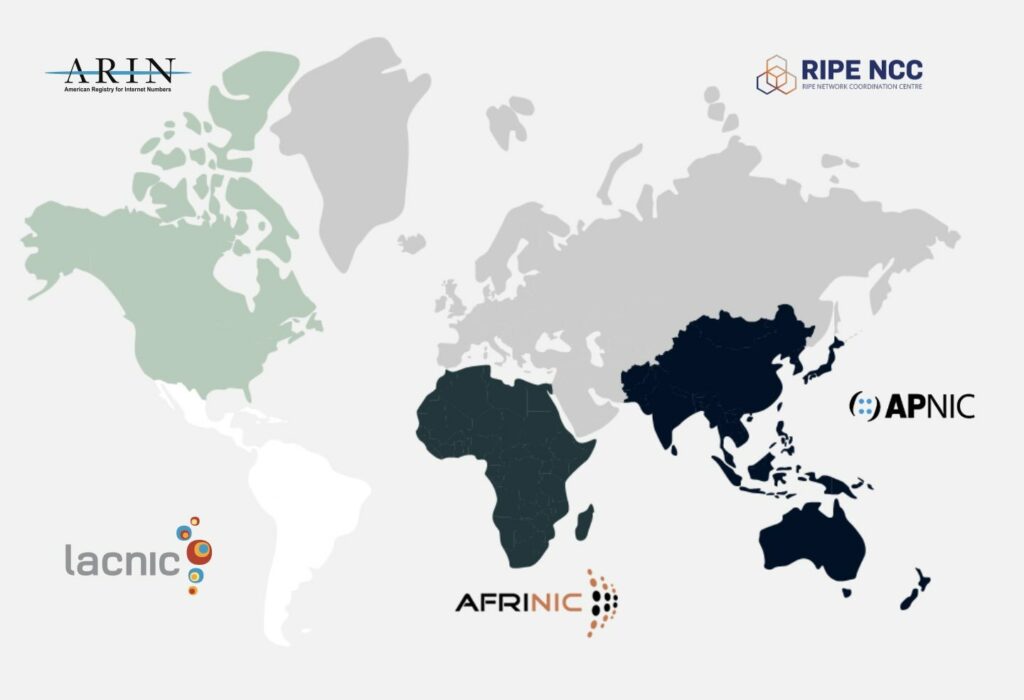
Before we dive into the specifics of a local internet registry’s duties, let’s establish the hierarchy that exists within internet resource management. At the top, we have IANA (the Internet Assigned Numbers Authority), which oversees global IP address allocation, among other critical functions. Below IANA are the five Regional Internet Registries (RIRs), each serving a different portion of the globe. RIPE NCC, for instance, covers Europe, Central Asia, and parts of the Middle East.
Members of an RIR, such as RIPE NCC, are recognized as Local Internet Registries. LIRs are responsible for the distribution and management of IP addresses within their region. They serve a variety of end users, which can include companies, charities, schools, or even individuals.
Responsibilities of a Sponsoring LIR
As a sponsoring LIR, there’s a myriad of responsibilities that you must uphold. Not only are you tasked with requesting and assigning Internet resources on behalf of your end users, but you also need to ensure that the registry remains updated, handle abuse-related matters, and perform due diligence ahead of any requests sent to the RIPE NCC. Additionally, you’ll represent your end user in any communication with the RIPE NCC.
Let’s look at these responsibilities in a structured format:
Action
Responsibility
Outcome
Best Practice
Resource Request
Request and assign Internet resources, such as IPv6 PI or AS numbers, on behalf of end users.
End users receive necessary resources for their own infrastructure.
Maintain communication with end users throughout the process.
Registry Maintenance
Keep the RIPE database up-to-date with accurate end user information.
Accurate reflection of end user details in the RIPE database.
Report changes in business structure, name, or address promptly.
Abuse Handling
Handle or delegate abuse complaints related to the end users’ network.
Swift resolution of abuse complaints.
Ensure end user contact information is reachable and updated.
Independent Resources and Transfers
It’s crucial to understand that independent resources, such as IPv6 provider-independent space or AS numbers, are owned by the end user, not the LIR. These resources can be transferred between sponsoring LIRs if, for instance, an end user changes their service provider. However, the LIR must ensure that these transfers are recorded accurately, and in cases where resources are no longer needed, they are returned to the RIPE NCC, not retained by the LIR.
IPv4 resources are a special case due to scarcity, and typically, end users will only receive IPv4 resources from the LIR’s own allocation. However, the LIR may assist the end user in obtaining IPv4 through the RIPE NCC’s Transfer Listing Service.
Updating the Registry and Handling Abuse Complaints
Keeping the RIPE registry up-to-date is not just good practice, it’s a requirement. Whether it’s a simple name change or a more significant event like a merger or acquisition, these changes need to be reported to the RIPE NCC promptly. This ensures the integrity of the registry and the rightful ownership and use of the resources.
Abuse complaints, which can arise from DDoS attacks, spam, or malware, need to be addressed either by the LIR or the end user. If the end user is unresponsive, the responsibility falls on the LIR. In extreme cases, where the end user is consistently unreachable, the LIR may consider terminating the sponsorship agreement.
Do’s and Don’ts for Sponsoring LIRs
To encapsulate the essence of a sponsoring LIR’s responsibilities, here’s a quick list of do’s and don’ts:
Do keep in touch with your end users to monitor their resource usage and changes in their status or structure.
Don’t allow end users to contact the RIPE NCC directly; the LIR should be the intermediary.
Do keep the RIPE NCC informed of all changes involving your end users.
Don’t use end users’ internet resources for your LIR’s operations.
Conclusion
In summary, a sponsoring LIR plays a critical role in managing internet resources for end users. By maintaining open communication lines, ensuring accurate registry data, handling abuse complaints, and performing due diligence, LIRs can provide excellent service while adhering to the rules set out by the RIPE NCC. Remember, the RIPE NCC is always available to assist with any questions or concerns related to your role as a sponsoring LIR.
If you’re involved in managing a local internet registry or are an end user seeking to understand your relationship with your LIR, I hope this article has been informative. For further guidance and resources, do not hesitate to reach out to the RIPE NCC directly.
Understanding Subnetting in Practical Terms: Designing Coffee Shop Networks
Welcome back to another blog post where we dive into the riveting world of network design. Today, we’re scratching the itch of a very interesting scenario: subnetting for coffee shops. I’ve been tasked with creating a network design that provides a robust and efficient IP addressing scheme for a series of new coffee shops. So, grab a cup of joe, and let’s embark on this caffeinated networking adventure together.
Introduction to the Scenario
Imagine you are launching a series of coffee shops, each requiring a distinct network to support employees, devices, and guests. You have a single /24 network at your disposal: 10.1.1.0/24. The goal is to carve out this network to accommodate three coffee shops, each with specific host requirements.
Each coffee shop consists of:
5 employees
1 server
2 Raspberry Pis
2 Wireless Access Points (WAPs)
Up to 20 guests at a time
Doing the math, that’s approximately 30 hosts, but let’s round it up to 40 hosts for some extra breathing room. The challenge is to create subnets based on these host requirements and not just arbitrary network divisions.
Technical Breakdown
The first step in subnetting, based on host requirements, involves determining the number of host bits needed to support the required number of devices. Using the principle that the number of hosts is 2n – 2 (where n is the number of host bits), we can deduce the correct subnet mask.
Hosts Needed
Host Bits (n)
Subnet Mask
Usable Host Range
40
6
255.255.255.192
26 – 2 = 62
…
…
…
…
…
…
…
…
Based on our requirements, we need to save (or reserve) 6 bits for hosts. Therefore, if we start with a /24 network, we need to convert it into a /26 network, which will provide us with 64 IP addresses per subnet, 62 of which are usable for hosts. In binary, the subnet mask for a /26 network is 11111111.11111111.11111111.11000000, which translates to 255.255.255.192 in decimal notation.
Subnet Allocation
With our subnet mask determined, we can now allocate subnets for each coffee shop. Since we are dealing with a /26 subnet, we will increment our networks by 64 for each subnet. Here’s how the networks for the three coffee shops would be divided:
Coffee Shop
Subnet
Usable IP Range
Broadcast Address
1
10.1.1.0/26
10.1.1.1 – 10.1.1.62
10.1.1.63
2
10.1.1.64/26
10.1.1.65 – 10.1.1.126
10.1.1.127
3
10.1.1.128/26
10.1.1.129 – 10.1.1.190
10.1.1.191
Conclusion
Subnetting can initially seem daunting, but when you apply it to a real-world situation like setting up networks for coffee shops, it becomes much more approachable. By breaking down the requirements, calculating the number of needed host bits, and determining the subnet mask, we’ve successfully created a subnetting scheme that ensures each coffee shop has a network tailored to its specific needs. Remember, practice makes perfect, and the more you work with subnetting, the more intuitive it becomes. So keep brewing up those network designs!
借助 INTERLIR Marketplace,您可以灵活地将租用的 IP 用作 Google Cloud 自带 IP (BYOIP)。 BYOIP 允许您为您的 Google Cloud 资源配置和使用您自己的公共 IPv4 地址。 此功能可以将您现有的 IP 地址与 Google Cloud 平台无缝集成,从而为您提供更多的控制权和便利性来管理您的网络基础设施。.
通过 BYOIP 将 IP 地址导入 Google Cloud 后,Google 将以类似于其自己提供的 IP 地址的方式管理它们,但有一些例外:
导入的IP地址仅供带来它们的客户使用,确保专用。
闲置或使用中的 IP 地址不收取任何费用,为客户提供成本效益。
Google Cloud does not allow overlapping BYOIP route announcements. This means that if an IP address range, such as 203.0.112.0/23, or a subset of it, such as 203.0.112.0/24, is already being advertised outside of Google, importing the same range or a subset of it into Google Cloud is not supported. Having overlapping route announcements with matching or mismatched prefix lengths between Google and another network can lead to unexpected routing issues and packet loss.
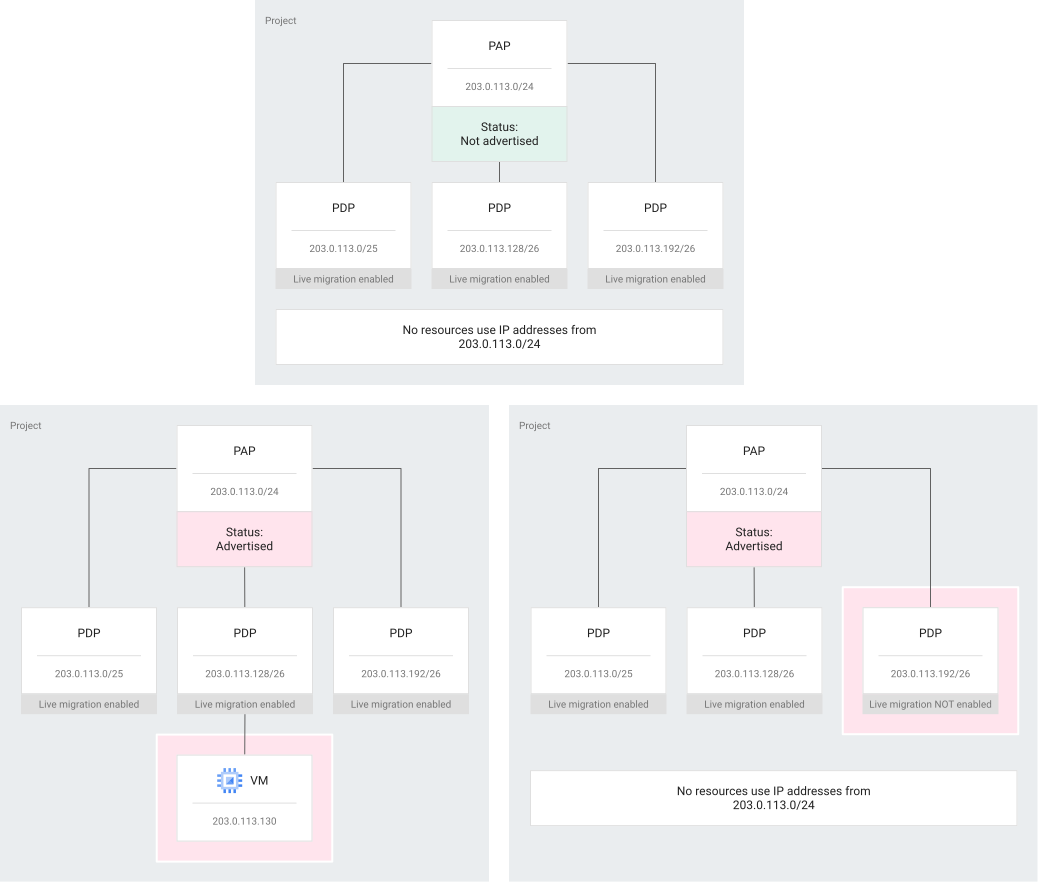
For managing the route advertisement of your imported prefix, Google Cloud offers a feature called live migration. Live migration allows you to control the timing of when Google Cloud starts advertising routes for your imported IP address range. However, it’s important to note that live migration is not available by default and needs to be requested from Google Cloud. To request access to the live migration feature, you can reach out to your Google Cloud representative.
概述
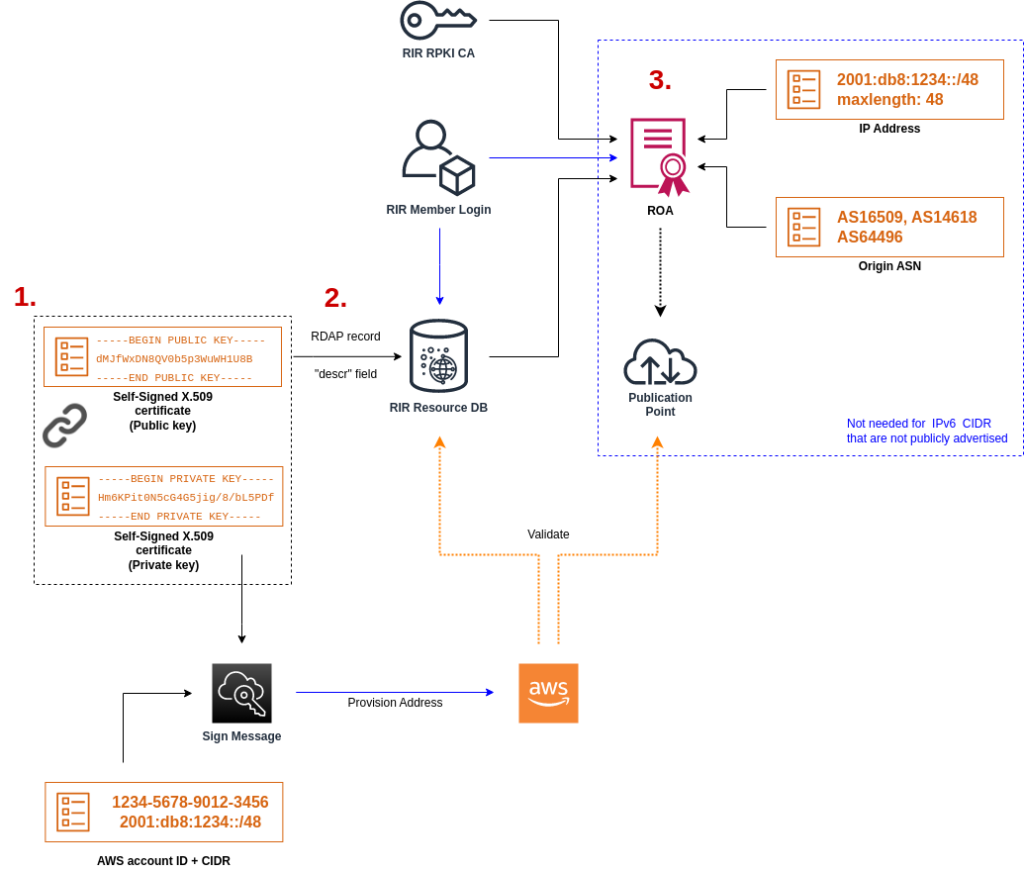
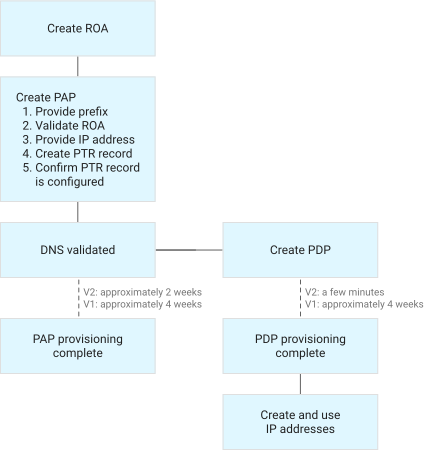
要将您自己的 IP 引入 Google Cloud,您首先需要创建一个公共通告前缀 (PAP)。 通过使用路由源授权 (ROA) 和反向 DNS 验证对此 PAP 执行所有权验证。 验证成功后,将配置此 PAP 到 Internet 的公告,但在进行配置之前不会公告前缀。 公开公布的前缀的配置过程通常需要长达四个星期的时间。 在配置等待期间,您将前缀划分为公共委托前缀 (PDP)。 这些 PDP 可以具有区域范围或全球范围,您可以选择进一步划分它们或使用它们来创建可分配的 IP 地址。 公共委托前缀的配置也需要长达四个星期的时间。 一旦公共委托前缀的配置完成,公共通告的前缀就会被通告到互联网。 如果您使用实时迁移,可能会涉及额外的步骤,因此建议参考 Google Cloud 提供的使用实时迁移的具体指南。
公开公布的前缀
公共通告前缀 (PAP) 是 Google Cloud 计算引擎中的一种资源,可让您将自己的 IP 前缀引入平台。 这使您能够将自己的前缀中的 IP 地址分配给 Google Cloud 资源。 PAP 代表路由通告的单个单元,Google 的全球骨干网从其所有存在点对其进行通告。 公共通告前缀内的 IP 地址始终使用网络服务层的高级层。 创建新的公共通告前缀时,它必须具有最小 CIDR 范围为 /24 的 IPv4 IP 范围。 无法创建具有较小 CIDR 范围的新公共通告前缀,例如 /25。 但是,创建公共通告前缀后,您可以灵活地将其分解为较小的公共委托前缀,例如 /24 或 /23。
公共委托前缀
公共委托前缀 (PDP) 是公共通告前缀中的特定 IP 块,配置为在定义的范围内运行,该范围可以是 GCP 中的特定区域或全局。 在将 IP 地址分配给您的项目或组织之前,必须将这些 IP 块委派并分配给特定范围。 Google Cloud 可以灵活地将公共通告前缀分解为多个公共委托前缀。 每个公共委托前缀都可以在您的 Google Cloud 项目中配置其自己的范围。 此外,您可以选择将单个公共委托前缀进一步划分为多个较小的块,但需要注意的是,这些较小的块必须具有与父块相同的范围。 在给定范围内,您还可以配置多个不连续的公共委托前缀,也称为子前缀。
IP地址
一旦从公共委托前缀创建 IP 地址,它们就只能在分配的特定项目和范围内使用。 项目中具有适当 IAM 权限的任何用户都可以将这些 IP 地址用于其指定目的:
compute.addresses.* 对于区域 IP 地址 compute.globalAddresses.* 对于全球 IP 地址
公共 IP 管理员角色
要为您的 BYOIP 前缀和地址指定管理员,您可以授予他们计算公共 IP 管理员角色 (roles/compute.publicIpAdmin)。 通过此角色,他们能够管理组织内的公共可路由 IP。
如果您需要使用热迁移,请为全球资源和区域资源创建单独的公共通告前缀。 在公共委托前缀上启用实时迁移需要指定范围区域。 不支持为启用实时迁移的公共委托前缀指定全局范围。 通过在一个公共通告前缀中包含区域前缀,在另一公共通告前缀中包含全局前缀,您可以单独管理它们。 然后,您可以处理区域资源的实时迁移,同时与您的 Google Cloud 代表合作管理全球资源的实时迁移。 这种分离可以更好地控制和管理实时迁移过程。
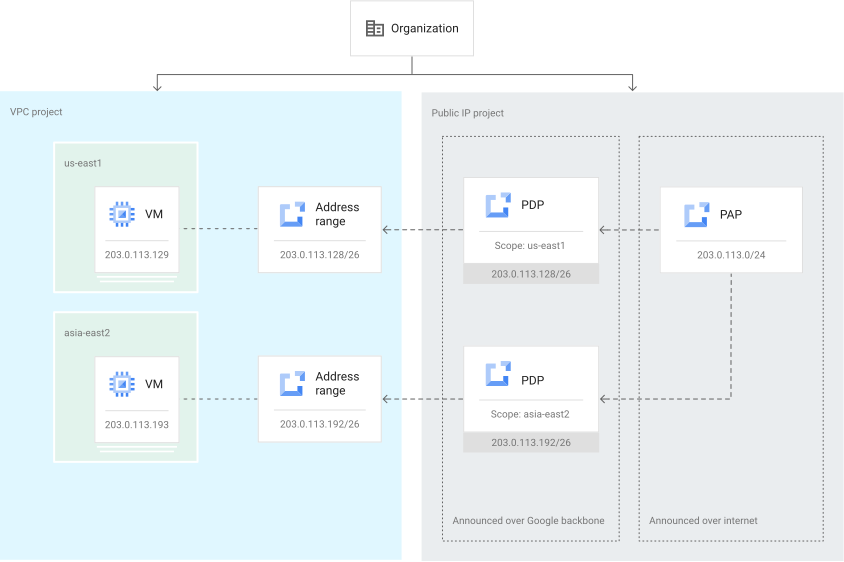
项目架构 Project architecture 我们建议组织利用集中式 IAM 权限和共享 VPC 等功能,在 Google Cloud 环境中提供改进的资源管理和安全性。
组织中的 BYOIP 地址管理
在此场景中,在组织内,指定一个名为“公共 IP 项目”的单独项目来管理 BYOIP 地址。 公共 IP 管理员负责监督组织的 IP 地址管理,在此项目中创建公共通告前缀和公共委托前缀。 当 VPC 项目需要公共 IP 地址时,公共 IP 管理员会在 VPC 项目内创建必要的 IP 地址。 该组织可以灵活地拥有多个项目,并且公共 IP 管理员可以将 IP 地址从中央“公共 IP 项目”委托给所有项目。 这种集中式方法简化了整个组织项目的 IP 地址管理。
Figure 3. You can use organizations and projects to manage BYOIP addresses.
BYOIP 通过共享 VPC 解决管理问题
在这个具有共享 VPC 的组织中,指定了一个名为“公共 IP 项目”的单独项目来管理 BYOIP 地址。 负责整个组织的 IP 地址管理的公共 IP 管理员已在此中心项目中创建了公共通告前缀和公共委托前缀。 当共享 VPC 主机项目或相关服务项目需要公共 IP 地址时,公共 IP 管理员会在共享 VPC 主机项目中创建必要的 IP 地址。 宿主项目和服务项目都可以从宿主项目访问 BYOIP 地址。 需要注意的是,不支持在共享 VPC 服务项目中直接创建 IP 地址; 所有 IP 地址管理均发生在中央“公共 IP 项目”内,并在组织内的相关项目之间共享。
Figure 4. You can delegate BYOIP addresses to a Shared VPC host project, but not to a Shared VPC service project. However, a service project can use BYOIP addresses that were delegated to the host project.
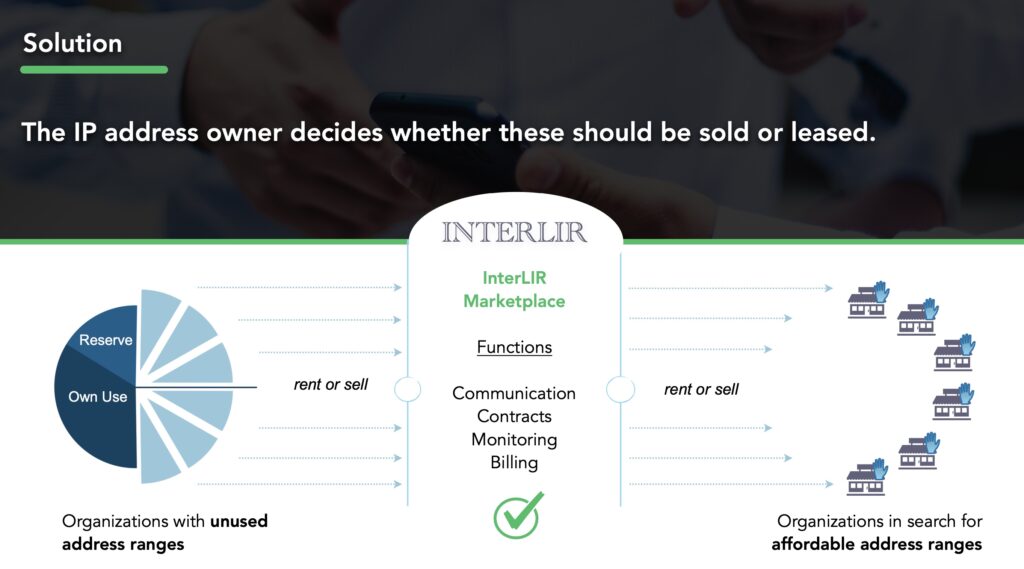
对 IP 块的需求不断增加,推高了价格,并将过度使用的 IP 空间转变为那些有兴趣销售 IPv4 网络的人的宝贵资产。 在 InterLIR Marketplace,我们提供业内人士的行业视角,确保您在向合格买家出售使用过的 IP 地址时找到最优惠的价格。 我们的专业专家致力于服务您的最大利益,因此请立即联系我们,发现您的额外 IP 在当今市场上的潜在价值。
不要让您的 IP 地址白白浪费; 它们的价值在于高效使用,而不是闲置在数据中心。 通过将它们放在公开市场上,您可以让精明的买家找到并有效地利用它们。 在 InterLIR Marketplace,我们拥有对这些市场的全面了解,并且我们现有的买家网络简化了寻找感兴趣的各方来购买您的 IP 地址的过程。 不要再犹豫了——立即开始向我们出售您的 IP 地址。
出售 IP 地址的过程可能非常耗时,尤其是在寻找合适的买家并协商最佳价格时。 然而,在知识渊博的经纪人的帮助下,这个过程可以变得更加容易。 可靠的经纪人充当您的代理人,促进与相关方的谈判,解决任何相关问题,并处理合同义务和付款细节。 通过与 InterLIR 合作,您可以减轻压力并最大化您的收入。
受益于十多年的行业专业知识,我们努力实现高效运营,在 24 小时内完成所有必要的任务。 我们技术精湛的团队专注于将 IP 地址从一个位置无缝转移到另一个位置。 如果您当前的提供商不再满足您的要求,请随时与我们联系。 请立即致电我们,了解我们如何满足您的特定需求。
在 RIPE 区域出售 IPv4 地址。
我们是一家位于德国的公司,为全球客户提供服务,重点关注欧洲、中东和亚洲部分地区 (RIPE)。 我们的合作伙伴关系专为希望从卖家处购买额外 IP 地址的买家而设计。 如果您对我们的位置或网络规模有任何疑问,请随时与我们联系。 无论您的 IP 转让经验水平如何,我们的团队都会为您提供帮助,确保流程顺利、无缝。
在全球范围内出售 IP 地址
InterLIR Marketplace 是一家经验丰富的公司,帮助人们出售他们的 IP 地址,无论他们身在何处。 我们从整个流程的开始到结束都提供优质的服务,并定期向感兴趣的各方提供最新信息。 InterLIR Marketplace 搜索潜在买家,以确保卖家为其 IP 地址获得尽可能最好的价格。 我们负责处理所有必要的文书工作,卖家在交易成功后会立即收到付款。 该公司致力于提供一流的客户服务并在整个过程中保持透明的沟通。 他们网站上的所有信息都经过彻底检查和双重检查,以避免出现任何意外。 InterLIR Marketplace 邀请那些有兴趣出售其 IPv4 块的人联系他们讨论细节。 如果他们无法达成协议,不用担心,所有销售都是最终的。